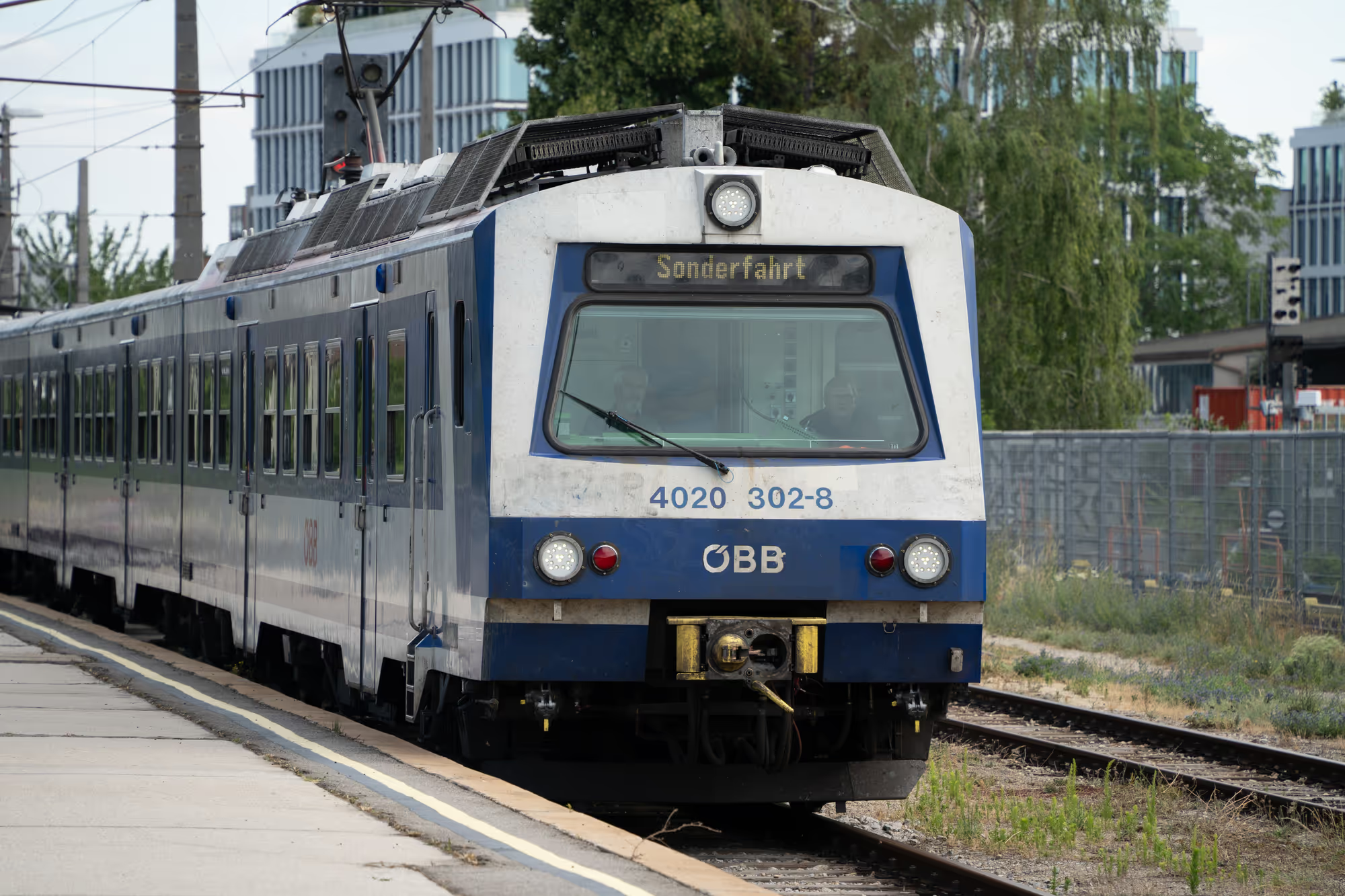
ÖBB 5047: The hero of branch lines
The life and end of the branch line hero

ÖBB 5047: The branch line hero
The prototype was the branch line railcar 5047.01, which was leased by the ÖBB and tested in detail. The ÖBB was not very enthusiastic about the concept. Since the vehicle was very prone to failure, the railcar was returned to the SGP in 1966, after the lease expired. ÖBB did not issue any follow-up orders. The only international follow-up order came from Syria and included 7 vehicles delivered in 1967.
After the end of steam traction, the branch lines were operated with a colorful collection of already outdated railcar types. By the end of the 1970s, hardly anyone believed that the ÖBB would buy new diesel trains. On the one hand, due to progressive electrification and on the other hand due to the closure of branch lines, there no longer seemed to be a corresponding need. It was not until 1983 that the ÖBB recognized the need to purchase new diesel multiple units. The decision for such a fleet of railcars came very late. Probably also because the old railcars were now approaching the end of their service life. When the tender was issued in 1983, the characteristics of the railcar were closely based on those of the VT 627 series of the Deutsche Bahn. The vehicle was intended for one-man operation from the very start and was to have multiple control. The railcar was also to be equipped with two end driver's cabs and the engine had to meet the increasingly strict environmental and noise requirements. Eventually, each model got a ticket machine, replacing the driver's job of selling tickets.
In 1985, the ÖBB awarded the Jenbacher Werke a contract for six new diesel trains based on the German series 627 train. The first model was completed in July 1987. After successful operation on the lines of the "Schweinbarther Kreuz“ in the Weinviertel region of Lower Austria, where the six 5047s were used in a quickly designed “special plan“, a total of 100 railcars with modified 5047 series and five sets (10 individual vehicles) of the 5147 series were built for the ÖBB. The Solo-5047 cost ATS 27 million at the time; a control car would hardly have been cheaper at ATS 22 million. Therefore, for the 5147, the solution came into play as a double railcar in the form of two close-coupled vehicles; control cars for the 5047 were not purchased. These two vehicle types would replace the older series 5044, 5144, 5145, 5146 and 5081, some of which dated back to the interwar period, were technically outdated and had reached the end of their economic useful life (see pictures below). Between 1987 and 1995, 100 5047ers were manufactured for the ÖBB.
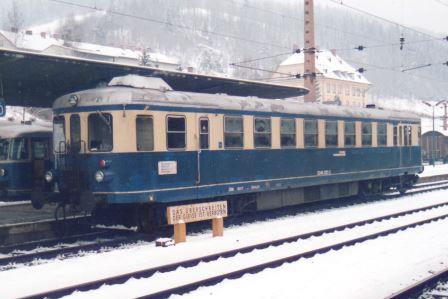
(02) (1938- 1988, most were destroyed in the second world war.)
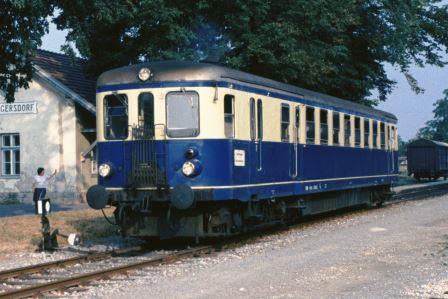 (02) (1951- 1993)
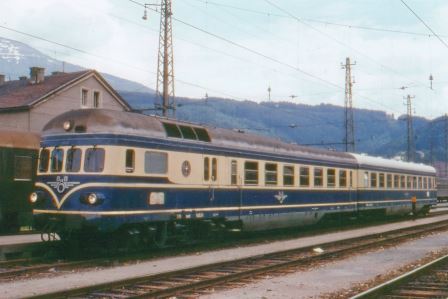 (02) (1952- 1997, nicknamed the blue lightning, started in long distance journeys, then in the 1970s, became a regional train model.)
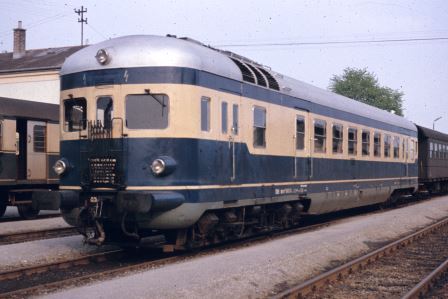 (02) (1959- 1997)
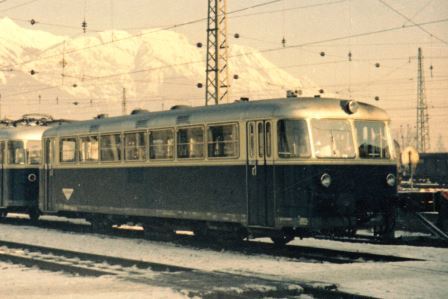 (02) (1964- 1994, nicknamed the track bus.)
 (03a.) (One of the two original models ordered by the Raab-Ödenburg-Ebenfurter Eisenbahn.)
In 1990, the Raaberbahn ordered two 5047ers, which were used by them until January 2017, which is when they were sold to another Hungarian company for test and measure journeys. In 2011, the Raaberbahn got seven more models from the ÖBB, which are still in use today on the Neusiedlerbahn.
 (03b.) (The two 5047ers the Steiermärkische Landesbahnen ordered in 1992 on their way from Graz to Weiz on their primary route as the S31.)
In 1992, the StLB ordered two 5047ers, which were in use mostly on the S31 route from (Graz) Gleisdorf to Weiz until January 2025, which is when they were sold to an association for preservation.
 (04) (The unique 5047er marked as T4.)
In 1995, the NVAG (Nordfriesische Verkersaktiengesellschaft) bought one 5047er to run between Niebüll and Dagebüll. They went bankrupt in 2003 and in 2004 T4, along with most of everything the NVAG had, was taken over by the successor of the NVAG, neg (Norddeutschen Eisenbahngesellschaft Niebüll GmbH). T4 also has a first class section.
 (03c.) (7047er in Semmering as a restaurant (Gaststube Semmering).)
While the 5047ers were being built, the ÖBB took a few old 5081ers (track buses) and repurposed them to aid the 5047ers. Two were made into 7047ers, which had more comfortable seats than the 5081er and others were made into 7147ers, which were only for bicycles and were used during the summer. The 7047ers, of which four were built, were used to assist the 5047ers with their passengers. The 7047ers and 7147ers could no longer travel on their own as their motors and driver areas were removed and they were used as extra carriages for 5047ers. Both types were also repainted to harmonise with the 5047ers. On the 31st July 1996, all 7047ers went into retirement. Two of them were almost immediately scrapped, another stood around somewhere until at least the summer of 1997 and was then scrapped and another was sold to a private person who turned it into a restaurant (see picture above). On the 30th November 1998, both 7147ers went into retirement. One of them went to a private collector and stood around in the open for years and rotted under weather conditions and vandalism and was scrapped or thrown away in 2018 by the collector while the other went to a private collector who kept it.
 (02) (5047er in the blood orange livery.)
 (02) (5047er in the grey white livery.)
The 33 5047ers delivered before 1990 were delivered in the warmer, cosier blood orange livery (first picture above) while the 67 5047ers delivered after from 1990 onwards were delivered in the cooler grey white livery (second picture above). In 2004, 14 5047ers were modernised and got a new livery in the current ÖBB colours and new seat covers, which were blue instead of brown as well as colour scheme changes inside. Seven others got the same new livery, but the inside stayed the same. (See picture below.)
 (02) (5047er with the new Schrägstreifen design.)
In contrast to all the railcars it replaced, with the exception of the 5081er, the entire drive system on the 5047 is located underfloor. The 5047er is powered by a 12-cylinder V-engine of the type Mercedes-Benz OM 444 or MTU 12V183TC12 with a displacement of 21.93 l and an output of 419 kW (570 hp). The same engine is also installed in the DB Class 628.2 railcars and, without intercooling, in the Classes 627.1 and 628.1. Power is transmitted via a turbo transmission with two Föttinger torque converters and a hydrodynamic brake. To increase cooling performance, the engine speed is increased when the hydro brake is applied. The bogie is driven on the side facing away from the multi-purpose room. This bogie also accommodates the magnets for the Indusi or, more recently, the PZB. The magnetic track brake is attached to the trailer bogie under the multi-purpose room. Originally, all 5047ers were equipped with an Indusi I60 system, analog train radio and GPS for train control operation. With the switch to GSM-R radio, the radios were also replaced. Since 2022, the Indusi has been gradually replaced by a PZB90. Since 1 January 2025, PZB90 has been mandatory for passenger trains on the ÖBB network.
From the 61st delivered railcar (5047 061) onwards, all subsequent railcars, with the exception of those for the StLB, were equipped with a vacuum toilet instead of the fall pipe toilet.
In the 1990s, the 5047ers were involved in several accidents, but repaired and sent back to service. In the summer of 2016, on the Almtalbahn, a 5047er had an accident with a lorry and was scrapped between the 08th and 11th October 2017 due to the damages. This 5047er became the first of its kind to be scrapped. Between 2016 and 2020, six other 5047ers were involved in accidents and while it is now known if they were scrapped, it is known that they were sent to permanent parking, a shell of their old selves, both literally and figuratively. Due to the electrification of the Marchegger Ostbahn and Rosental, there was not as much demand for diesel trains, so when the timetable change occured at the end of 2022, three more 5047ers were sent into permanent parking, followed by another in the summer of 2023. Today, 89 of the 100 5047ers are still in service.
In 2024, the 5047ers were still in regular scheduled service on the following routes:
- Erlauftalbahn
- Leobersdorf Railway
- Traisentalbahn
- St. Pölten-Krems
- Kamptalbahn
- Inner Aspang Railway
- Gutenstein Railway
- Wiener Neustadt-Sopron
- Innkreis Railway
- Salzkammergut Railway section: Attnang-Puchheim-Schärding (Hausruck Railway)
- Almtalbahn
- Mühlkreis Railway
On the Leobersdorf Railway in the section Leobersdorf – Weißenbach-Neuhaus, the Schneeberg Railway, the Gutenstein Railway and the Mattigtal Railway, they were largely replaced by the series 5022 and the DB series 642. However, they continue to be used there unscheduled and at the end of the day. They are also used unscheduled on the outer Aspangbahn. There are a few 5022s on the Kamptalbahn, the Krems-Herzogenburg railway line and the Traisentalbahn. On the Wiener Neustadt–Sopron railway line, the 5047 series comes to Hungary. On the Innkreisbahn they arrive as scheduled at the border station Simbach(Inn) in Germany. During the summer months, two pairs of trains on the Mühlkreisbahn are operated as scheduled with more modern bicycle carriages. They are deployed from Linz; Urfahr/Rottenegg; Krems and Wiener Neustadt Neustadt. They were also formerly based in Villach, Klagenfurt, Vienna East, Graz, Wels, Mürzzuschlag, Innsbruck and Knittelfeld.
 (02) (Fall pipe toilet in the 5047.)
 (02) (Ticket machine and door to the driver's cabin with a way to speak to him/her.)
 (02) (Driver's area.)
 (02) (Request stop button. If it glows, a stop has been requested.)
 (02) (Old interior of a 5047. In the old interior, there are two sections, a smaller and a bigger one, seperated by a wall and door. One area was an area to smoke, the other was an area not to smoke.) (Lights are off.)
 (02) (New interior of a 5047. Note that the interior is no longer split. This is because, at the time of the redesign, smoking was no longer allowed in ÖBB trains, so there was no more need for seperate sections.) (Lights are on.)
The ÖBB has said that they wish to retire the model by the end of 2028, meaning that for many, the end of an era is nearing. However, the 5047 will (or at least should still be) remember as the hero/rescuer of the branch lines, a name it rightfully earnt after many years.
Little additional fact: The doors of 5047er trains are still operated by handles.
Please note that some translations are literal and may not be fully correct.
Sources & credits
- 01. https://austria-forum.org/af/AustriaWiki/%C3%96BB_5047
02. https://www.bahntechnisches-bildarchiv.at.htm
03a. https://www.bahnbilder.de/bild/oesterreich~unternehmen~gysev/1295364/5047-501-steht-am-7092000-in.html
03b. https://www.bahnbilder.de/bild/oesterreich~strecken~steirische-ostbahn/1359849/graz-die-zwei-5047er-mit-den.html
03c. https://www.bahnbilder.de/bild/oesterreich~personenwagen~schienenbus-beiwagen-7047/1070203/7047-002-6-semmering-30122018.html
04. https://de.wikipedia.org/wiki/%C3%96BB_5047