Introduction to the old generation of the ÖBB's regional trains
The technical details of Austria's older regional train types which still operate today
Bogies are the structural framework that hold and connect the wheels and axles to the rest of the carriage body.
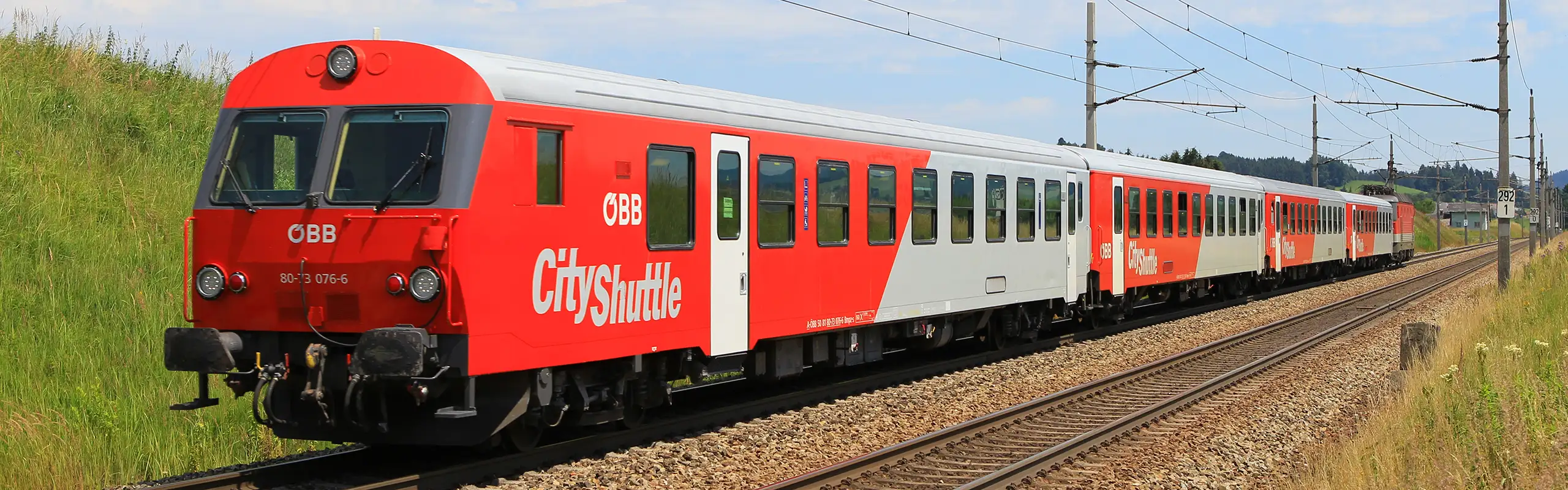
City Shuttle*
Double Decker City Shuttle (Wiesel)

(Picture from Siemens SGP Technik from 1998/1999.)
The train got the nickname "Wiesel" because it was (and is) considered fast and agile.
In September 1997, after the Oebb had spent more than six billion (Austrian) Schillings to upgrade its trains and the trains (like the one shown above) were part of these new purchases and these trains became one of the most important in Austria's regional train network. These trains were also the first double decker trains that the Oebb used.
Intermediate carriage details:
- The toilets are toilets operated with a closed freshwater flushing system.
- Track gauge: 1,435 mm
- Number of axles: 4
- Track curve radius in train formation / solo (empty): 150/80 m
- New wheel diameter: 920 mm
- Length over buffers: 26,800 mm
- Length of the car body: 26,400 mm
- Pivot distance: 20,000 mm
- Bogie wheelbase: 2,500 mm
- Ceiling height in passenger areas: 2,000 mm
- Ceiling height in porch: 2,020 mm
- Ceiling height in driver's cab: 2,102 mm
- Clear entry door width: 1400 mm
- Window divider: 1,800 mm-1,800 mm
- Window size (field of view): 1400x800 mm
- Passenger compartment aisle width: approx. 520 mm
- Seating: Face-to-face seating with a proportion of row seating: approx. 60%
- Number of seats: 114
- Seat dividers for vis-à-vis seating: 1,800 mm
- Row seating: 900/875 mm
- Seat width: min. 450 mm
- Top speed: 140 km/h
- Empty weight: approx. 48 t
- Axle load: 17 t
- Buffer pressure force of the entire wagon: 1,500 kN
- Buffer pressure force passenger compartment: 2,000 kN
- Buffer pressure force in the driver's cab: 2,000 kN
- Braking range, load-dependent across the entire loading condition: min. 150 bra
- Battery voltage: 24 V +/-30%
Control carriage details:
- Track gauge: 1,435 mm
- Number of axles: 4
- Track curve radius in train formation / solo (empty): 150/80 m
- New wheel diameter: 920 mm
- Length over buffers: 27,130 mm
- Length of the car body: 26,280 mm
- Pivot distance: 20,000 mm
- Bogie wheelbase: 2,500 mm
- Ceiling height in passenger areas: 2,000 mm
- Ceiling height in porch: 2,020 mm
- Clear entry door width: 140 cm
- Window divider: 1,800 mm-1,800 mm
- Window size (field of view): 1400x800 mm
- Passenger compartment aisle width: approx. 52 cm
- Seating: Face-to-face seating with a proportion of row seating: approx. 60%
- Number of seats: 102
- Seat dividers for vis-à-vis seating: 1,800 mm
- Row seating: 900/875 mm
- Seat width: min. 450 mm
- Top speed: 140 km/h
- Empty weight: approx. 49 t
- Axle load: 17 t
- Buffer pressure force of the entire wagon: 1,500 kN
- Buffer pressure force passenger compartment: 2,000 kN
- Buffer pressure force in the driver's cab: -
- Braking range, load-dependent across the entire loading condition: min. 150 bra
- Battery voltage: 24 V +/-30%
- Drive: Push-pull train operation with locomotives of the 1142 series
These city shuttles started their service between Vienna and Payerbach-Reichenau in September 1997. They are suitable for people with limited mobility.
One floor city shuttle train

(Picture from 1998/1999)
Intermediate carriage details:
- Clear entry door width: 70 cm
- Passenger compartment aisle width: 51 cm
- Number of seats: 80
- Empty weight: 37 t
- Top speed: 160 km/h
Control carriage details:
- Length over buffers: 26,400 mm
- Clear entry door width: 90 cm
- Passenger compartment aisle width: 51 cm
- Number of seats: 65
- Empty weight: 40 t
- Top speed: 160 km/h
- Drive: Push-pull train operation with locomotives of the 1142 series
These city shuttles have open toilets (they drop everything straight onto the tracks) and started their service in Kärnten in and near Klagenfurt and Villach towards the end of 1997.
*The city shuttle trains can be operated without a control carriage if a locomotive is attached. In this case, pushing the carriages will not be possible. Furthermore, the locomotive doesn't have to be attached at the front of the train if it has a control carriage as it is possible to connect the locomitve's systems to the control carriage's systems. In this way, the locomotive can also be controlled from the control carriage and (at least partially) vice versa. They are not suitable for people with limited mobility due to the fact that stairs are the only way to enter the train.
S-Bahn and Regional trains
S-Bahn (Type 4020)

(Picture from 1998/1999)
The type 4020 is composed of three parts; it has a control carriage, an intermediate carriage and a carriage which powers the train (and can transport passengers).
General details:
- Year of construction: 1978
- Track gauge: 1435 mm
- Length over buffers: 23,300 mm
- Floor height above top of ground level: 1150 mm
- Clear entry door width: 1400 mm
- Pivot removal: 1600 mm
- Total wheelbase: 18500 mm
- Drive wheel diameter: 950 mm
- Continuous power output: 1,200 kW
- Starting tractive force: 117 kN
- Continuous tractive force: 61.5 kN
- Rated power (according to UIC 614?): 4x300kM - 1200 kW
- Perfomance: 4 motors with 1200 kW
- Weight: 63 t (railcar)
- Top speed: 120 km/h
- Axle pressure: 15.6 t unoccupied
- Weight of mechanical part: 39 t
- Weight of electrical part: 23.4 t
- Type of current: Single-phase alternating current 16 2/3 Hz
- Overhead line voltage: 15000 V
- Translation: 1:4.73
- Brake: Thyristor resistance brake
- Maximum braking force of the electric brake: 95 kN (120 to 55 km/h)
- Track curve radius: >150 m
- Supplier: Simmering-Graz-Pauker, Graz plant
- Electrical part: Brown-Boveri, ELIN Siemens
- Engines: Four 8-pole externally and internally ventilated mixed-current motors, each with 300 kW continuous power, thyristor-controlled with resettable asymmetrical bridge circuit (LUB7). Automatic control for driving and braking.
- 2 current collectors, BBC pneumatic quick-action switch, transformer with 1,720 kVA continuous power
- Drive: Axle-bearing drive, with sprung large wheel
Powering carriage details:
- Length above dome plane: 23300 mm
- Car body length over sheet metal: 22950 mm
- Width across sheet metal: 2872 mm
- Train driver's compartment: 01
- Seating capacity: 56
- Standing room: 134
- Seat width: 990 mm
- Aisle width: 690 mm
- Dead weight: 63000 kg
- Maximum weight: 79000 kg
Intermediate carriage details:
- Length above dome plane: 22800 mm
- Car body length over sheet metal: 22500 mm
- Width across sheet metal: 2872 mm
- Height above SOK: 43750 mm
- WC: 2
- Seating capacity: 64
- Standing room: 146
- Seat width: 990 mm
- Aisle width: 690 mm
- Dead weight: 32000 kg
- Maximum weight: 50000 kg
Control carriage details:
- Length above dome plane: 23300 mm
- Car body length over sheet metal: 22950mm
- Width across sheet metal: 2872 mm
- Height above SOK: 3750 mm
- Seating capacity: 64
- Standing room: 136
- Seat width: 990 mm
- Aisle width: 690 mm
- Dead weight: 33000 kg
- Maximum weight: 50000 kg
These trains started their service in 1978 in the metropolitan area of Vienna as well as in Tirol. They are not suitable for people with limited mobility due to the fact that stairs are the only way to enter the train.
Regional train (types 5047/5147)

(Picture from around 2000.)
This train type is a single carriage which is capable of powering itself; it is diesel powered.
Technical details of both the type 5047 and 5147:
- Years of construction: 1987 to 1995
- Drive wheel diameter: 840 mm
- Wheel diameter: 840 mm
- Bogie wheelbase: 2000 mm
- Length over buffers: 25,420 mm
- Perfomance: 419 kW
- Power transfer: Hydraulic
- Seating capacity: 62
- Top speed: 120 km/h
- Service weight: 43.7 t
- Supplier: Jenbacher Werke
These train types was developed to operate on branch lines without electricity and to retire similar train types built in the 1930s and 1960s. They can be found in two liveries; they have the same design but the background colour is either a grey blue or blood orange (which is seen in the picture above). They can also be found in a different, little newer livery which is mainly used for the City Shuttles (Schrägstreifen Design). They are not suitable for people with limited mobility due to the fact that stairs are the only way to enter the train.
Sources:
https://www.oebb.at/en/reiseplanung-services/im-zug/unsere-zuege
https://www.eisenbahn.gerhard-obermayr.com/oebb/die-oebb-fahrzeuge/
For more information, see the articles: "ÖBB 4020: The second S-Bahn generation" and "ÖBB 5047: The hero of branch lines". Articles on city shuttles are yet to come.