ÖBB 4020: The second S-Bahn generation
The life and end of the S-Bahn series 4020
ÖBB 4020: The second S-Bahn generation
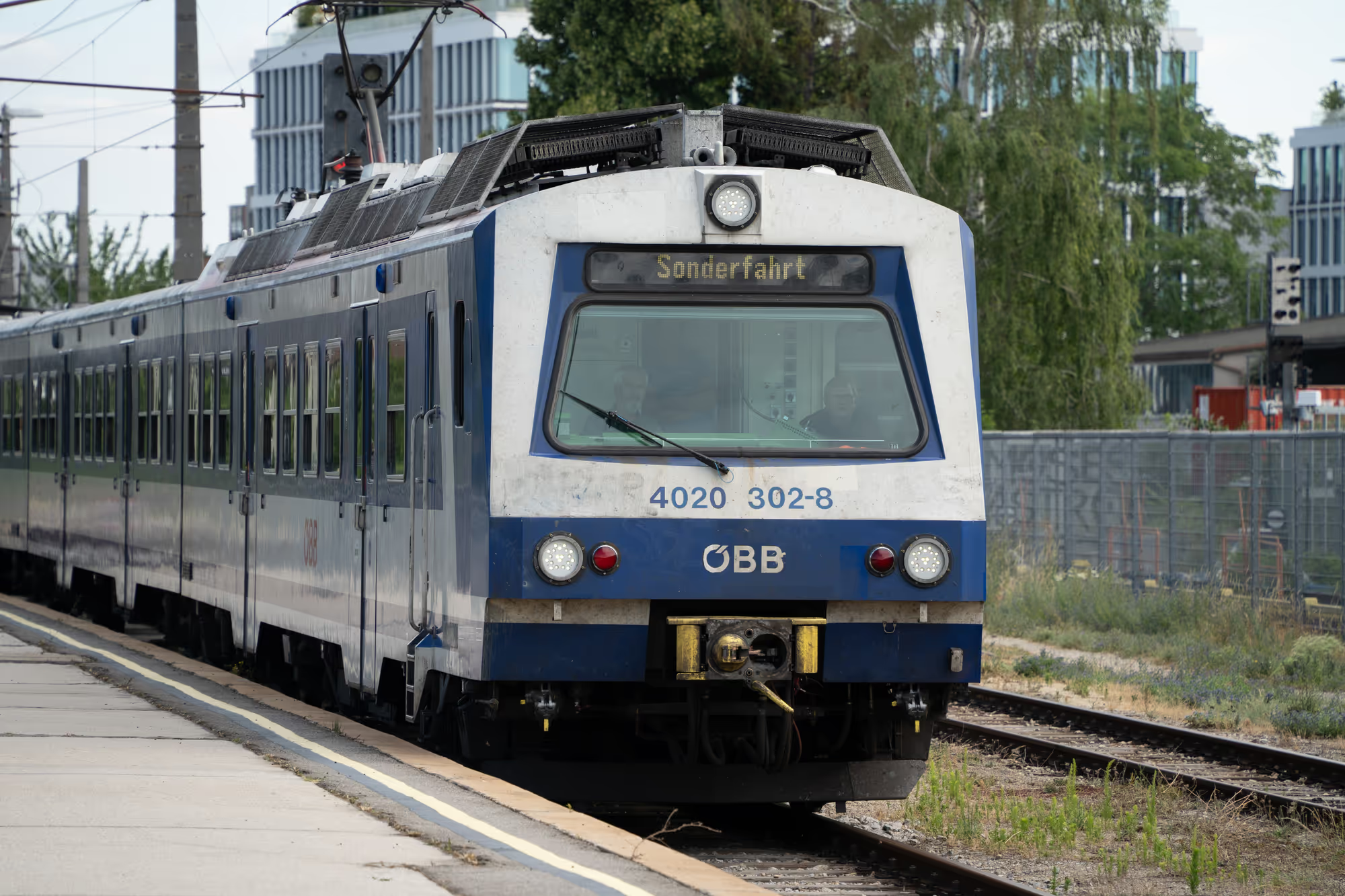
For almost half a century- 48 years, the 4020 series was the symbol of the Viennese S-Bahn. The trains were in generations of people's daily lives. When these trains started their operations in 1978, around 1,5 million people lived in Vienna. They were built by Simmering-Graz-Pauker AG between 1978 and 1987 to serve as a replacement for another S-Bahn legend, the 4030 series, which was the first ÖBB series with swing sliding doors and which was retired in 2004 (one of these can be seen in the railway museum Schwechat; see picture below).
 (02)
 (01) (Two legends side by side.)
To be very specific, the 4020er is the carriage that powers the train, the 6020er is the carriage that can also be used to control/steer the train and the 7020er is the carriage(s) in the middle without either. They were used in all of Austria, though mainly on Viennese S-Bahn routes. In the mid-1970s, the ÖBB decided to purchase new vehicles for local transport in metropolitan areas, but especially for the Viennese S-Bahn. After several test runs with railcars from other railway administrations, the ÖBB commissioned a total of 120 three-car Class 4020 trains from SGP for traffic on the Vienna S-Bahn as well as regional traffic in metropolitan areas such as the Tyrolean Inn Valley and the greater Rheintal, Linz and Innsbruck areas, amongst others before eventually fully moving to Vienna. The planning of the 4020 series was based on the concept of the older 4030 series, but otherwise took completely new paths: The 4020 series railcars were equipped with thyristor control and mixed-current motors, powerful electric dynamic brakes and cradleless bogies with air suspension.
In October 1978, there were several test voyages conducted. On the 01st December 1978, they fulfilled their maiden voyage as a test journey on the now S80 line. At the start of 1979, they started running regularly on the Viennese main route in the direction of Stockerau. Once they started their scheduled voyages, it was realised that the from the 4030er series taken Rotation-Compression system was not enough for the suspension of the train, so these were replaced with Screw-Compression systems. These still weren't enough, so these were also replaced with piston compressors, which permanently solved the problem.
With the reopening of the suburban line in 1987, railcars 4020 095 to 100 were equipped with door space monitoring with light barriers for train attendant-free operation. Railcar 4020 006, which crashed in Süßenbrunn in 1991, was the first railcar to undergo a major overhaul, during which some modifications of the major overhaul carried out from 1993 onwards were already tested. Due to the lack of two other vehicles of the 4020 series involved in the accident during the long repairs, one of the two accident sets, the 4020 056, was also used as a two-car set in the following months. This ran on line S80 or as a regional train between Gramatneusiedl and Wampersdorf. In the years from 1993 onwards, all railcars underwent a major overhaul, which was recognizable both technically and externally by the changed livery. However, parts of the work have already been carried out on all railcars without major repairs. The livery was only slightly changed; instead of ultramarine blue with a blood-orange colour in the background, the livery turned into ultramarine blue with a grey white in the background. From 2002 onwards, the railcars that had already been converted at that time were equipped with an emergency brake override (NBÜ), and the others received it during the following major overhaul. From 2011 onwards, train image monitoring had to be installed for a train attendant-free trial operation in double traction, as rail violations had led to train separations that were not indicated to the driver.
 (Blood orange colour)
 (02 (Grey white colour)
 (01) (Inside area of a 7020 prior to the overhaul, with tables and bins for trains running in Vorarlberg, though both were removed eventually, around the time of the great overhaul.)
 (01) (Inside area of a 4020 after the overhaul.)
Originally, the 7020 carriage was a smoking carriage and had two drop pipe toilets. However, when the trains were overhauled, the carriage was no longer a smoking carriage. During the overhaul, there were plans to transform the toilets into closed system toilet- vacuum toilets. However, this did not happen in most trains. Instead, one of the toilets was simply folded up, leaving only one toilet. With time, a few trains did have that toilet transformed into a vacuum toilet, therefore possessing two toilets, but most didn't and were left with one toilet.
As part of the main repairs carried out from 1993 onwards, the units were modernized in many details: the roller belt displays for the target display with their characteristic blue lettering on a white background were replaced by matrix displays. The inner roller belts with the line layout were also removed and all roller belt displays were removed from the 2000s onwards because the control units were not compatible with those of the matrix displays. The doors of all sets were supplemented with doorway monitors with light barriers, similar to those previously only found on the Vienna suburban line. Automatic time-dependent door closing was also implemented. From now on, a start-up lock also prevented starting with the doors still open, which was necessary for the expansion of one-man operation (0:0 operation). The interior was modernized and the paintwork was slightly modified (grey-white instead of ivory). The seat covers were now blue/violet patterned, the previously blood-orange door areas, as well as the brown luggage racks and trash cans, were traffic-purple. Some units were also repainted in 2004 in the red and grey Schrägstreifen design intended for local transport by the ÖBB at that time, which also included a change to the interior into a grey blue (instead of purple) and new labels and pictograms. However, some were modernized sparingly and received grey luggage racks and seat frames, but no grey wall coverings. Two more units were repainted in the Schrägstreifen design a few years after their major overhaul. For this reason, they also retained the interior design of the first modernization. The brake types were also changed.
From the end of 2002, all sets were also equipped with an emergency brake override (NBÜ local transport) and renumbered to the 4020.2 series (the serial numbers were increased by 200). In order to minimize maintenance costs on the one hand and improve visibility for the driver on the other, the trains were equipped with LED headlights between 2014 and 2015. In 2016, due to requirements for train attendant-free operation, the original door handles were replaced with others and electronic door sensor edges were retrofitted. In this context, a visual and audible door closing warning has also been installed, which is active during every opening and closing process. However, the previously used warning tone announcing the forced closing of all doors was retained. To increase safety, the intermediate car of a certain train set was rebuilt in 2023 and received interior and exterior cameras on a trial basis. According to interior stickers, this is done for scientific purposes. In September 2023, unit 4020 242 was converted into a disco train to mark the 100th anniversary of ÖBB. The seats in the 7020 were removed and disco equipment, disco balls, etc. were installed during the special trips.
In and from 2024 onwards, there were about 29 4020er trains sets operating regularly, 28 of which operated daily on Viennese S-Bahn routes. If there was a lack of these, any capable, available train set was used.
Former operational routes in Tirol, Vorarlberg and Oberösterreich:
- Arlbergbahn between Innsbruck Hauptbahnhof and Ötztal as well as occasionally Landeck.
- Train route Lindau–Bludenz and their branch routes to St. Margrethen and to Buchs SG (end of 1984 until 2006).
- Brennerbahn between Innsbruck Hauptbahnhof and Brenner/Brennero.
- Karwendelbahn between Innsbruck Hauptbahnhof and Garmisch-Partenkirchen.
- Rudolfsbahn and occasionally Ennstalbahn between Amstetten and Kleinreifling and occasionally Liezen/Selzthal.
- Summerauer Bahn between Linz Hauptbahnhof and Summerau.
- Unterinntalbahn between Innsbruck Hauptbahnhof and Kufstein.
On the above routes, the 4020er trains were replaced by 4023/4024 and 4744, 4746 and 4748 trains (which were built in the 2010s and 2020s). From May 2018 until the timetable change in December 2020, these trains also ran until Hegyshalom. On this route, they have been replaced by Talent trains of the MAV.
In 2016, the first capable 4020er trains were parked permanently and in spring 2019, the ÖBB started scrapping 4020er trains, including these and a few others, in Wien Jedlersdorf, which is also where most of them were permanently parked. From the start of 2019 to the timetable change in December 2020, a few permanently parked 4020ers were reactivated due to a lack of capable trains and the renting of some more modern trains. After the timetable change in 2020, these 4020ers were taken back to their permanent parking and countless others were scrapped. From the timetable change on the 13th December 2020 until the timetable change in December 2022, 21 more were sent to permanent parking despite a lack of capable trains, including the last two 4020ers with green walls and the at the time second oldest 4020er. In April 2023, countless 4020ers, which until then were permanently parked in Wien Jedlersdorf and Floridsdorf were sent to Romania to be scrapped, leaving 35 more 4020ers for passenger transportation, one of which was turned into a disco train and five more got sent to permanent parking, so, in 2024, only 29 of the originally 120 4020ers were left for passengers to use. The disco train is currently parked somewhere, not being used for normal passenger voyages, but is still capable of being used as a disco train.
Fun Facts:
- The average 4020er has driven around 4,8 million kilometres, which are about 120 orbits around the Earth.
- The record for kilometres driven by a 4020er is approximately six million kilometres.
- The oldest running 4020er before the total retirement of the type was built in 1983.
- The 4020er got the nickname of TV due to its large windscreen.
A few more technical details:
- Maximum speed: 120 km/h
- The average train set should have 184 seats.
- Mass: 127,4 t
- Average train set length: 69.000 mm
- The motor has a power of 1.200 kW
- Acceleration: 0.7 m/s2
On the 03rd July, the final two journeys of the 4020er took place between Wien Franz-Josefs-Bahnhof and Tulln for fans and the media to say goodbye. There are several initiatives to save a few 4020ers and those that won't be saved will be used for spare parts and eventually scrapped. I can tell you from personal experience, the ÖBB first guts their trains and sends the empty shells to be scrapped. When was the last time you saw a Speisewagen on an old Intercity? The last time I did was before we got the 2025 timetable. Then, guess what I saw standing on a permanent parking track a few months later? A row of about 12 completely gutted shells of old Intercity Speisewägen. For many, the 4020er is a piece of their childhood, it certainly is for me, and will be remembered for a long, long time, as a legend too.
Please note that some translations were done literally and may not be fully correct, especially the terminology.