The Father of the Personal Computer: a Story of Steve Jobs
Steve Jobs was a revolutionary CEO, most notably under his lead iPhone was made, his company NeXT was acquired by Apple and he singlehandedly changed the trajectory of Apple forever. Rest in Peace, a great man and leader alike.
The Beginning
Steve Jobs was born on February 24th, 1955. His biological parents "were two University of Wisconsin graduate students, Joanne Carole Schieble and Syrian-born Abdulfattah Jandali." (Short Biography of Steve Jobs) Jandali met Schieble at the University of Wisconsin. Almost immediately after birth, Steve was adopted because Schieble's parents did not approve of her relationship with Jandali; Steve was then adopted by the Jobs family. Paul Jobs was a machinist, and he would fix cars as a hobby. He went from his birthplace in San Francisco, California, to Cupertino, California. 2 years after adopting Steve, Clara and Paul adopted Steve's (non-biological) sister Patricia Jobs. In 1959, the Jobs family moved to Mountain View, California. Paul built a workbench for his son to "pass along his love of mechanics".
Jobs faced challenges in school; he would often resist authority figures, get in trouble frequently, and even get a few suspensions. Steve's father would often teach Jobs how to disassemble and build radios and other electronic devices. This sparked his interest in technology from a very early age. In 1967, after Steve's family moved again to Crist Drive in California and he began studying at Cupertino Junior High, he met one of his first friends: Bill Fernandez. This friend would later introduce him to Steve Wozniak, a very important person later on. At the age of 12, Steve lived near a Hewlett-Packard plant. He saw his first computer and knew immediately he would do this for work. He once asked William Hewlett for some computer parts required for a school project — William Hewlett, taken aback and surprised by Jobs' boldness, offered an internship along with the parts.
Apple: The Two Steves and the Not Batman (Although Still Rich Like Bruce) Wayne
At the age of 17, he began studying calligraphy, the art of writing well, but then dropped out in 1972. Then, in 1974, he began working at Atari as a result of a remake of the classic "Pong" game, that Steve Wozniak had made; Atari believed it to be Jobs' creation and hired him. In 1974, Jobs was living a "simple life": in a los Gatos, to save money for his upcoming trip to India, recommended to him by a friend for his spiritual journey. He spent 7 months there, despite his guru passing away before Jobs' arrival. He said "The Indian people... do not use intellect like we do, they use intuition... this had a big impact on my work". Just a year and a half later, Jobs and Wozniak built the Apple 1 in 1976, Ronald Wayne who had a 10% stake in Apple Inc. took it out almost immediately. Jobs was the "marketer" and business strategist, while Steve Wozniak made the actual "Apple 1". And so Apple Computers was founded by Steve Jobs, Wozniak and Ronald Wayne — who shortly after co-founding the company left Apple.
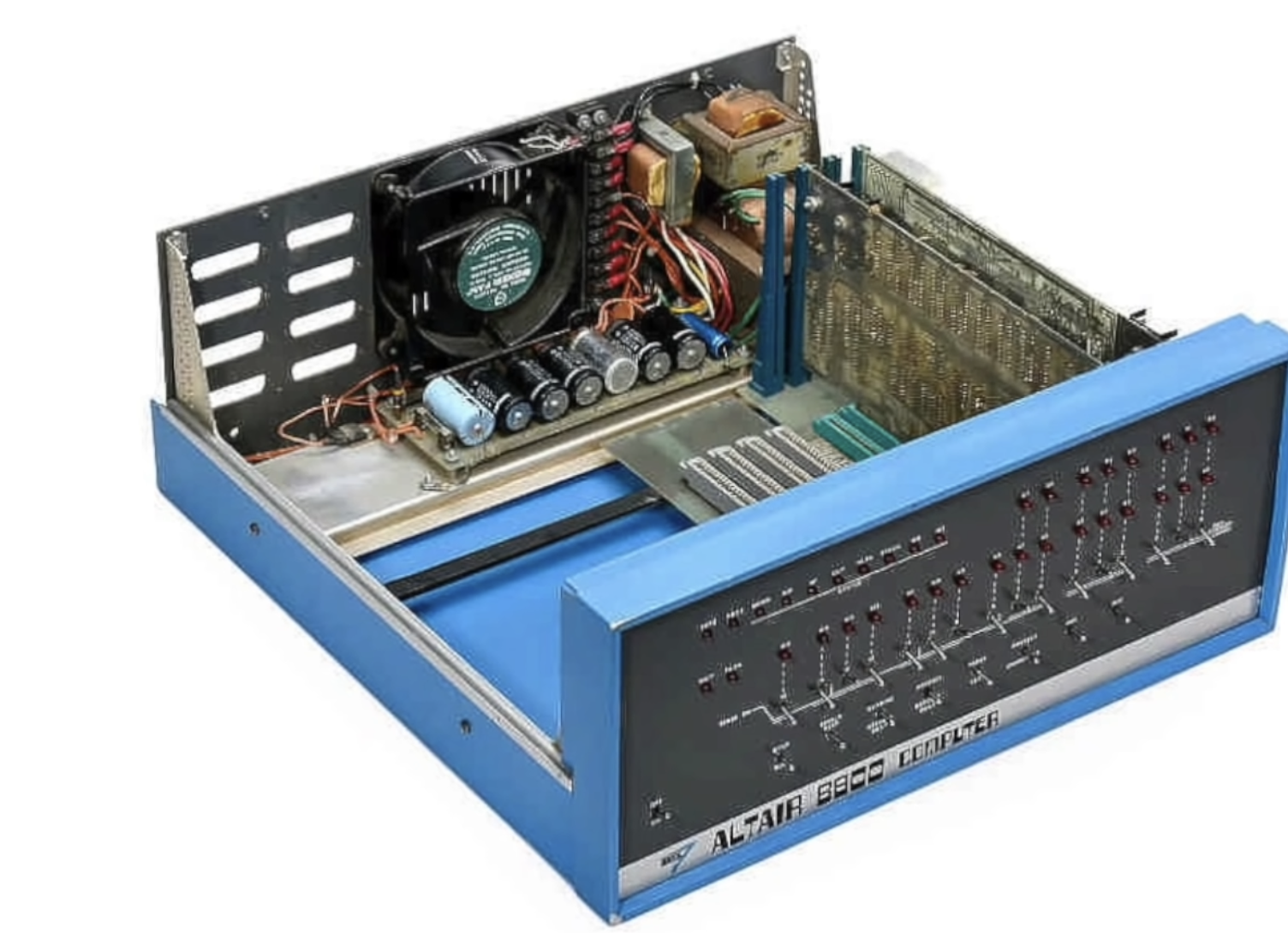
Both Steves, attended the "Homebrew Computer Club" together, which gathered in California's Menlo Park in 1975. Wozniak saw his first MITS Altair there, which nowadays looks nothing more than a collection of lightbulbs; Back then it was a kit based build it yourself "computer", Wozniak was inspired by this and set out to make a "typewriter based" keyboard computer thing.
So, Wozniak built a computer with a typewriter-like keyboard and the ability to use a regular television as its screen. This was the Apple 1. In 1977, Jobs finally found an American Business man, Mike Markkula, who gave Jobs a loan of 250,000 which is worth upwards of 1,080,000 in todays money. Mike Markkula became employee No. 3.
By August 1981, Apple had done it, it was among one of the top 3 microchip computer companies. For the next few years, It was all good. Although IBM in that month itself had released the IBM PC, Apple would release an Advertisement titled "Welcome, IBM. Seriously." Bill Gates was at Apple the day of this IBM PC announcement and noted how unbothered Apple were about it. Unfortunately, it took Apple a year to realize what happened and by the time they did... The PC had overtook the Apple II in 1983 as the best selling computer.
Sculley-osis: The Back Breaking Hire
Apple's board told Jobs he needed to hire new people, they went through about 20 but Jobs rejected them all, finally he came across John Sculley, the CEO of Pepsi-Cola, he asked him "Do you want to sell the rest of your life selling sugared water or do you want a chance to change the World?" to ask Sculley to serve as Apple's CEO. Apple's business was focusing on the clearly failing Apple III (Text Based, so no GUI) Computer, while the "Lisa" group worked on something never seen in a consumer grade Computer — a Graphical User Interface; or as most of us call it, a "GUI". This team introduced words such as "Cursor", "Mouse", "Desktop", and "Icon" into the computation vocabulary.
By 1983 the Lisa had released!... And failed quite miserably. But by 1984, Apple had proved, they were a powerful computing force, competing with IBM, Apple I and II were clear successes — the Lisa and Apple III, not so much. Nonetheless, Apple needed a hit, and they needed it desperately. This hit came in the form of the first affordable computer Apple would make (ironic now that you think they had the same A-HAH moment with the Neo). This Computer took inspiration from apples once again and added an "a" to the name of a variety of apple "McIntosh" which Apple Computers turned into "Macintosh". Now this project was only contributed to by Jobs post 1981, 2 years before that it was a personal project of Jef Raskin's who began work on a cheap consumer grade (non GUI) computer, however he left in 1982 — 2 years before the release, although the computer that was released was quite different from his work, he did start the project and name the mac, which we are grateful for to this day.
The Mac always had the chance to disappoint, considering its advertisement as the Computer to change the world, but then again Steve Jobs is Steve Jobs for a reason, he knew his audience, he know what made this computer special and how it would be used by all kinds of people. He gambled a lot, selling many GUI based productivity activities for a cost much lower than anywhere else. This combined positioned them directly against IBM, the - at that time - most trusted computer brand, ones career often depended on, IBM or the others, mostly IBM came on top. If Apple wanted to be a separate identity from "others", it needed to create it, on January 22nd of 1984, an add by apple aired. The add showed a famous Athlete wearing a Mac branded Tee, Mac was the last hope. She was the only colorful person among all the bald blue branwashees, lectured by "Big Brother". Anna (the athlete) then came and hurled a hammer she was holding into the screen, freeing the bald blue people.
Just 2 days after the advert aired, the Macintosh was released; Bundled with two apps to flaunt it's interface, "MacWrite" and "MacPaint". Although it gained a massive following, some deemed it a toy due to its Graphical User Interface. The GUI also called for a whole recoding of earlier Text Based Applications to run on the Mac.
The two leaders Sculley and Jobs had radically different leading styles which led to a fair share of arguments, including about price, while Jobs wanted the Macintosh to launch at $1,000, Sculley thought it was going to be difficult, so shortly after its announcement the price took a hike to $2,000, but again Sculley knew it would not suffice so the Macintosh went on sale at $2,495.
Such disagreements were only fueled by the financial issues the company began to face. The sales of the Macintosh began to Plateau, the Lisa had been discontinued and Jobs made no effort to hide that his initial admiration for Sculley had disapeared. The board told Sculley to "rein Jobs in", he did, but not until March 1985, nearly 2 years after Sculley joining the Company. Sculley visited Jobs in his office to tell him that Jobs' responsibility of the Macintosh team had been taken away. Sculley later told the BBC in 2012 "When the Macintosh office was introduced in 1985 and failed, Steve went into a very deep funk... He and I had a very big disagreement... and eventually the board... agreed that my position was the one they wanted to support."
Jobs and Sculley had different visions for the Company, Jobs wanted the closed architechture Macintosh (Like they achived in 2020 with the M chip) as a direct competitor to the IBM PC, while Sculley wanted open architecture computers like the Apple II & III which were more immune to IBM PC's market. Sculley had no control over Chairman of Board's (Steve Jobs's) Macintosh Division, it and Apple II division operated as though they were two separate companies.
The NeXT (STEP)
In Apples January 1985 annual meeting, nether the Apple II division nor the employees were mentioned, some even left including the only other co-founder of apple left alongside Steve Jobs: Steve Wozniak, stating the company had "been going in the wrong direction", and sold most of his stock. The Mac's clear failure at defeating the IBM PC, cemented the position of Sculley in Apple, but as we all know by now... Steve won't go without a fight. In May, for a business trip Sculley needed to leave the United States of America and Steve saw this as the perfect moment to seize control over the country. He told the senior members of his own time in confidence, which included Jean-Louis Gassée, who was going to take over from Jobs on the Mac team. Jean-Louis told Sculley and the CEO cancelled his trip. The following morning, Sculley confronted Steve in front of the Board and then asked the Board to choose between the CEO or Chairman of Board, and they backed Sculley. Steve was promoted to Chairman which took day-to-day tasks, so that he could not interfere with the company; Knowing this, Sculley completely remodeled the Company. Only 4 months later, the co-founder handed in his resignation.
Now we all want to know what happened to the company after all 3 co-founders left, right? Well I will not torture you with that information, all I will say is that once Jobs resigned, apple was releasing flop after flop, or in more honest words: it was launching crap after crap, almost every product they sold would fail horribly.
However, Steve was not failing, he had begun another business, NeXT with only $7 miillion. But he was not alone, a number of Apple employees made the transition with Steve. In its first year NeXT made the NeXT Cube, or the NeXT computer, a powerful one for its time. As NeXT began to near bankrupcy, Jobs caught the attention of the billionaire Ross Perot, who invested heavily in NeXT pre NeXT Cube.In 1986 Steve funded the company that is now Pixar, so there was that... He was the executive producer for the Pixar and Disney film "Toy Story", anyway back to the main article. And wouldn't you know it! Apple was still failing, anyway... Chrisann Brennan, and Steve Jobs worked out joint custody of their child, Lisa Brennan and then changed her last name to Lisa Brennan-Jobs, while Lisa and Steve got closer. :)
His birth sister, who he met after finding out about his biological parents helped in this. Although, he did not contact his biological parents in Clara Jobs' lifetime. When Steve was 31, in 1986 Clara was diagnosed with Lung Cancer, he spent a lot of time with her, getting to know about her background and his adoption, which motivated him to find his biological parents. After his mother, Clara, passed away at the age of 62, he got permission from Paul Jobs (father) and then contacted his biological mother. He then met up with her and in this meeting Schieble apologized for sending him away and they would develop a friendly relationship and spend christmases together. On this first meeting, Schieble told Jobs of his sister Mona Simpson, who wasn't aware Jobs existed. They got to know each other and he said, "we became good friends... I couldn't imagine a better sister".
Jobs met his later wife, Laurene Powell, in 1989 during a lecture at the Stanford Graduate School of Business, he said he couldn't take his eyes off her, "felt very giddy", and kept losing his train of thought. They would be together for the rest of his life, excluding a few times, Jobs Proposed on the 1st of January in 1990. And they married on the 18th of March, 1991, in a Buddhist celebration at the Ahwahnee Hotel in Yosemite National Park. Around 50 people, including Paul Jobs and Mona Simpson. Reed — Jobs and Powell's first child was born in september 1991. Paul Jobs, Steve's father died more than a year later on March 5th, 1993. The Jobs-Powell couple would then have two more children: Erin, born in August 1995 and Eve who was born in 1998. They then relocated to Palo Alto in California.
Following 1990, NeXT hardware stopped selling and NeXT then moved to being a software only vendor, they sold NEXTSTEP which was a operating system development environment that OS X is still to this day based on. (Aside: Recently renamed to just MacOS rather than OS X, it is the base of all the updates, for example MacOS Tahoe is not MacOS 26, it is MacOS 10.26)
Employee Number 0: The NeXT Chapter
By this time, Apple, as discussed before, desperately needed that spark.— It desperately needed that spark, the spark of creativity, the spark of ingenius marketing, it needed Steve Jobs back. Their earning annually were — for the first time — less than the previous year. Not only that, but IBM had continued to out-earn Apple since the mid-1980's, for it established itself as a dominant work/office computing behemoth. Apple would also be facing off against Microsoft which had been preparing Windows 3, which was a competitor to the "all-graphical Macintosh System Software" — Now there's a mouthful. The Board realized the water was up to their necks now and bought NeXT in February of 1997, they would later use the core features of NeXTSTEP to design "the all-new" (Sam time) OS X which is now just MacOS, because OS X was such an important update, it is now embedded into each and every update. Post-acquisition Steve was an advisor, then appointed Interim-CEO and finally, became the CEO of Apple (hopefully he fired the Snitch Jean-Louis). NeXT was not a particularly great business, his rash micromanagement and his way of management made the company fail, however he learnt so much from it that he was able to finally become a great CEO at the company he co-founded. Jobs cancelled a lot of the aforementioned crap like the Newton, Cyberdog and OpenDoc (Do not go look those up, I am disgusted apple ever thought to do such things).
iThinkDifferent
When Steve saw the state the company — his company was in, he know he had to be Steve Jobs again, not for him... but for the "the crazy ones. The misfits. The rebels. The troublemakers. The round pegs in the square holes. The ones who see things differently. They’re not fond of rules. And they have no respect for the status quo. You can quote them, disagree with them, glorify or vilify them. About the only thing you can’t do is ignore them. Because they change things. They push the human race forward. And while some may see them as the crazy ones, we see genius. Because the people who are crazy enough to think they can change the world, are the ones who do.". For them. So, he got all the top Apple employees together in the auditorium and while wearing shorts and sneakers asked everyone, "what's wrong with this place?", he cut everyone and answered, "It's the products! So what's wrong with the products? The products suck! there's no sex in them anymore!" This was because Apple's identity was Steve's decisions, once he left, Apple lost that. Prices hiked and no one bought Macs! The product line was nearly as bad as the Samsung smartphone line up today, almost... It was quite frankly impossible to differentiate the models from one another. This turned customers and confused them while also damaging Apples public perception. Jobs began to make changes that would make Apple his Apple again. This began in the 1997 Macworld Expo when he announced Apple would be entering into a partnership with Microsoft, which included a 5 year plan of Office for Macintosh along with a $150 million investment! They also dropped any charges against Microsoft infringing on patents.
Coming to the fun part, I mean the iMac, not the metal flat chinned things I mean the original, translucent plastic, pink, blue, green etc. It was a hit among all generations, this was the first time Apple felt like it could do something. Steve being Steve continued to produce hit after hit, hit after hit, launched the iPod in 2001 and then... "there's just one more thing" at 9:41 a.m. on the 9th of January in the year 2007... "an iPod, a phone, an internet communicator, an iPod, a phone... Are you getting it?!" Chills — pure chills every time I hear those words. This man lost his biological parents, moved 4 times as a child, got bullied, had no friends, met one guy, who introduced him to another guy, they built a company from nothing, they got investors, he got his power stripped, he lost his company, the company he worked his life towards and thought "it's nothing."—made a new company, this company was bought by his old company, pulled Apple back from the brink with nothing but his harsh management and now he and his wonderful team decided to make up a completely new type of product that would revolutionize the world as he sadly didn't know it...
The Final Keynote...
In 2011, Jobs took a third leave of absence, after announcing services like Mobile Me which failed but also its "successor": iCloud which is still going strong to this date. His medical situation only continued to degrade, his condition became so serious that he was forced to resign as Apple's CEO in August of 2011. For the next six weeks his health continued to degrade and he stayed at home as Apple's Chairman. He sadly passed away at around 3 p.m. on October 5th in the year 2011 due to a pancreatic tumor which caused respiratory arrest. Thankfully he was with his family when he passed, but realized the lost time, saying "oh wow, oh wow, oh wow" as he fell unconscious. He passed away a few hours later.
The world did not lose a guy, just another CEO; we lost the Shakespeare of technology, the only person capable of selling the plastic case'd iMac and have it be bought as "professional". Who looked at the customers and saw not living cash but rather people, everyday people who needed a change, the dreamers, the rebels, the misfits. Most of you reading, never met him, maybe didn't even hear about him... But what you need to know is that the world you are in right now, would not have been possible had not been for his very very harsh management style — He was the father of the technology that the world you were born into relies upon. He was a Legend. A Visionary. A Rebel... A Legend. A Visionary, "Are you getting it?!". The world lost the one wizard who was willing to sacrifice the status quo, to let the norm be worthless just to deliver a product to the consumers that would alter our lives. He was unafraid: Rest in Peace, Steven Paul Jobs.