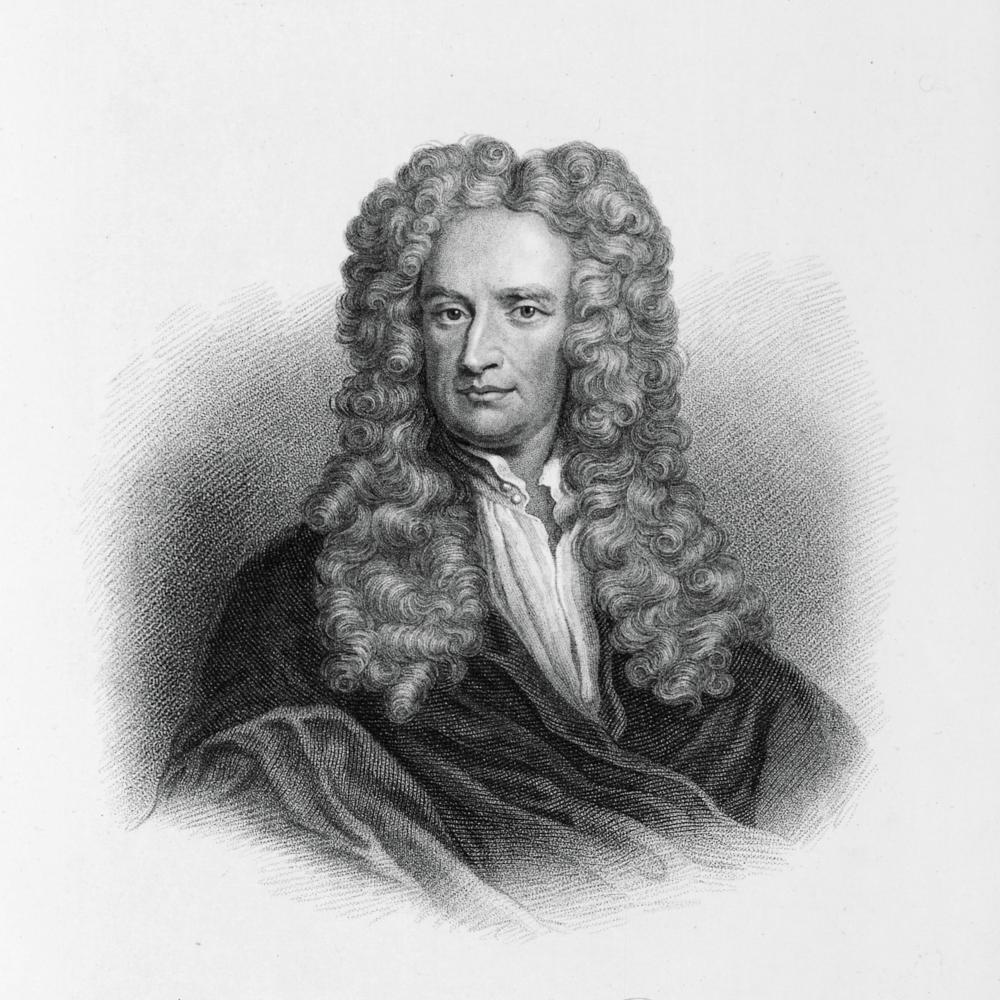
Sir Isaac Newton: The Man Who Invented Gravity
Have you ever asked yourself why the Newton pendulum is called the Newton pendulum? In this article, you will have the explanation of that, and you will also learn about the man who invented gravity and a new form of math to explain it. Additionally, you are going to learn what he is doing on one of the first Apple logos!
His Early Life
Sir. Isaac Newton was born on January 4, 1643, in Woolsthorpe, England. Before he was born, his father died, and as a child, he was a Quiet and introverted child. In his free time, he was interested in mechanical models of clocks and windmills. This showed an early interest in science and engineering, which he later made into his career.
Newton attended the University of Cambridge (Trinity College). He enrolled as a "sizar," or a student who received financial support, but in return, he performed duties, or in this case, served wealthier students. And in general, he came from a modest background compared to other students. Newton studied Aristotle's philosophy and classical texts. But Newton went far beyond the syllabus, studying modern thinkers of his own like Galileo Galilei and Johannes Kepler.
Newton's Scientific Work
One of the Biggest contributions by Sir. Isaac Newton is the author of the Laws of Motion, Gravity, Calculus, and Optics. There is a very fun fact I know about Newton is that he Invented Calculus just to explain the laws of gravity, as he couldn't do so with the math in the 1600s. In the contributions to the laws of motion, he talked about the three fundamental laws (Grade 7 VIS). The laws are:
The First Law, or law of inertia, states that an object will remain at rest or move at a constant speed in a straight line unless acted upon by a force.
The Second Law explains how force affects motion:
F = ma
This means that stronger forces cause greater acceleration, while heavier objects resist changes in motion.
The Third Law states that for every action, there is an equal and opposite reaction, explaining interactions like walking or rocket propulsion.
Together, these laws allow scientists to predict motion and have shaped physics for centuries.
And this is basically the reason why Newton's Pendulum is called so, as the pendulum demonstrates these Laws.
In optics, he contributes Prisms or the way light can refract into all the colors of the rainbow, and the first successful reflecting telescope.
And of course Universal Gravitation, where he developed Calculus to describe why the apple fell from the tree (greatly seen in the first Apple logo (Img. 2)), and there he explains how and why objects fall on earth. This is also why the ISS (International Space Station) can stay in such a low orbit, as it falls because of gravity but misses Earth and continues this repeatedly.
Later Life
In his Later life, Sir. Isaac Newton Became that President of the Royal Society and worked at the Royal Mint to help reform Britain's currency. In 1705, Isaac Newton was knighted, and so he became Sir Isaac Newton. Isaac Newton.
After he passed in 1727, he defined the next 200 years of physics with his work and became the foundation for modern engineering.
Bibliography:
- Isaac Newton. Philosophiæ Naturalis Principia Mathematica. 1687.
- “Isaac Newton.” Encyclopaedia Britannica, Encyclopaedia Britannica, Inc., www.britannica.com/biography/Isaac-Newton
- Halliday, David, et al. Fundamentals of Physics. Wiley, 2013.