CRISPR: The Bio-Technical "Edit" Button
This is an automatic translation. Read the original
Introduction
Imagine you're writing an essay on your computer, and you notice a mistake in one paragraph. You don't have to rewrite the entire essay—you just find the mistake, select it, delete it, and type in the correction. Easy, right?
For most of human history, changing our DNA has been impossible. If you inherited genes that caused disease or other problems, you were stuck with them. But in recent years, scientists developed a tool that works kind of like the "find and replace" feature in a word processor. This tool is called CRISPR, and it's one of the most exciting breakthroughs in biology. It lets scientists find specific mistakes in DNA and fix them—or make changes we want to make.
This discovery was so revolutionary that the scientists who developed it won the Nobel Prize in Chemistry. And it's going to change medicine, agriculture, and our understanding of life itself.
What is DNA and Why Does It Matter?
Before we dive into CRISPR, let's understand what DNA is and why fixing it could be so powerful.
DNA stands for deoxyribonucleic acid (don't worry about that name—everyone just calls it DNA). It's the instruction manual for building and running your body. Every cell in your body contains DNA, and that DNA contains the instructions for everything about you: your eye color, height, whether you can roll your tongue, and unfortunately, your risk of getting certain diseases.
Think of DNA like a cookbook. It has recipes (called genes) that tell your cells how to make proteins. Proteins are the workers that do almost everything in your body—they build muscles, fight infections, carry oxygen in your blood, and thousands of other jobs.
The problem: Sometimes the recipes in your DNA have typos or mistakes. A small change—sometimes just one letter out of three billion—can cause serious diseases. These mistakes can be inherited from your parents, or they can happen randomly.
Common genetic diseases include:
- Cystic fibrosis - affects the lungs and digestion
- Sickle cell disease - causes painful and damaged red blood cells
- Hemophilia - blood doesn't clot properly
- Huntington's disease - causes damage to the brain
- Certain cancers - caused by mutations in DNA
For most of history, if you inherited a genetic disease, medicine could only treat the symptoms. But CRISPR changed everything.
What is CRISPR?
CRISPR is a tool that scientists can use to edit DNA. The name stands for "Clustered Regularly Interspaced Short Palindromic Repeats," but that's just the scientific name. What matters is what it does.
Here's the key insight: CRISPR didn't come from scientists in a laboratory. It came from bacteria.
Bacteria sometimes get infected by viruses. When this happens, bacteria have an immune system (called CRISPR) that captures a snippet of the virus's DNA and stores it. If that virus attacks again, the bacteria remembers it and destroys the invading DNA. The bacteria basically has a "wanted poster" of bad DNA, and if it sees that DNA again, it destroys it.
Scientists realized: "Wait—we could use this same system to target and fix human DNA mistakes!"
How Does CRISPR Work?
CRISPR editing works in three main steps:
Step 1: The Search
Scientists create a guide that tells CRISPR what DNA to look for. This guide is like a bloodhound—it can sniff out a specific sequence in all three billion letters of your DNA and find the exact spot that needs fixing.
Step 2: The Cut
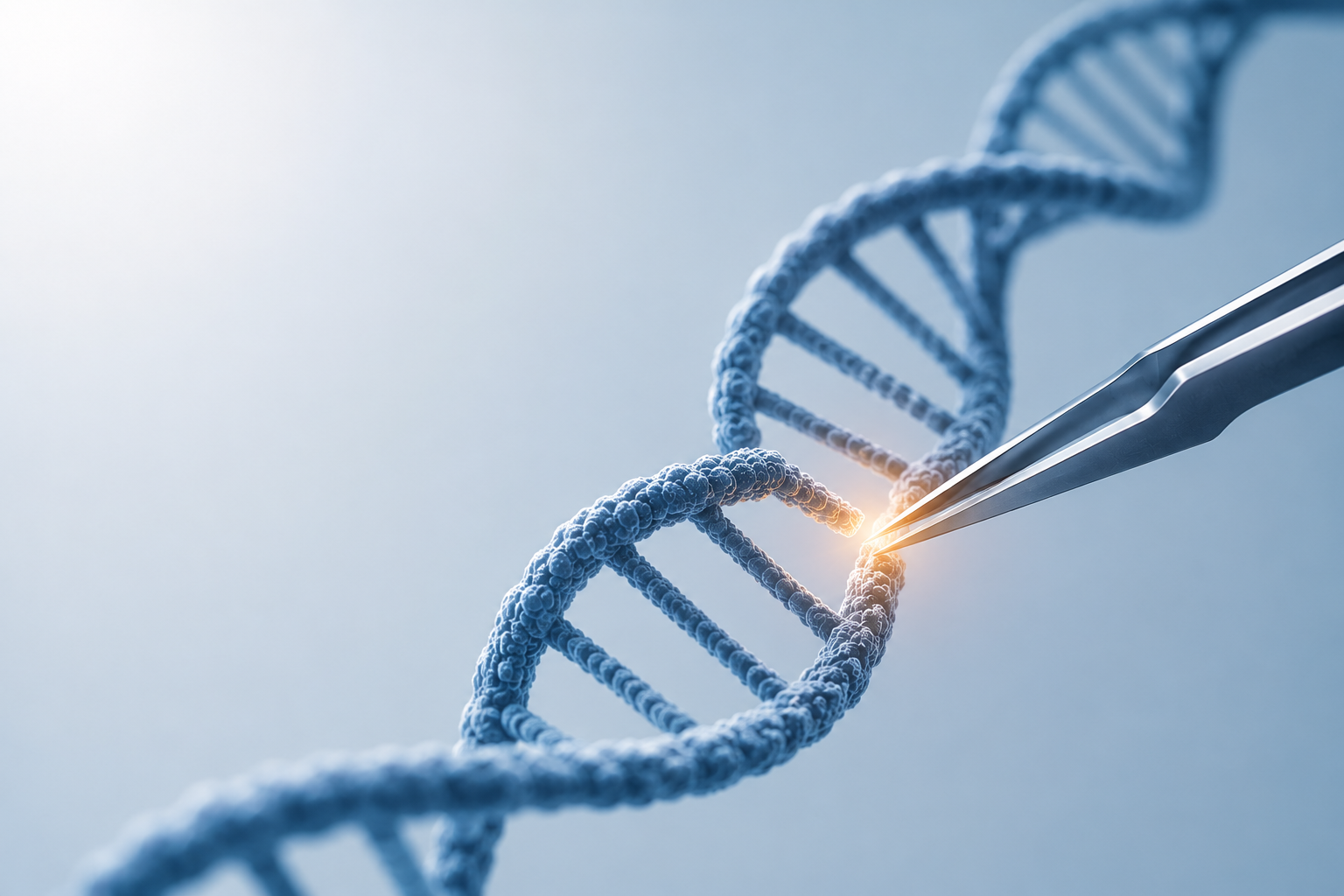
Once CRISPR finds the target, it uses a molecular scissors called Cas9 to cut the DNA at that exact spot. The DNA strand is broken into two pieces.
Step 3: The Fix
Now that the DNA is cut, one of two things can happen:
Option A - Delete the Problem: The cell's natural repair system kicks in and glues the DNA back together without the problematic part. This works well when you need to remove a harmful gene.
Option B - Replace the Problem: Scientists can also give the cell a corrected version of the gene. The cell's repair machinery uses this corrected version as a template and rebuilds the DNA the right way. It's like having a corrected paragraph ready to paste in.
An Analogy to Help You Understand
Imagine your DNA is a long, long book with three billion letters. You notice that on page 500, someone wrote one wrong letter by mistake, and this typo causes the whole story to be confusing and broken.
CRISPR works like this:
- The Search: You use the "Find" function to search for that specific mistake among all three billion letters. CRISPR locates it.
- The Cut: CRISPR cuts the page right around that mistake.
- The Fix: Either you tear out the damaged section, or you paste in a corrected version from a backup copy.
Now the story is fixed and makes sense again.
Where is CRISPR Being Used Right Now?
CRISPR isn't just theory—it's already being used to help real people:
Treating Blood Diseases
In 2020, the first CRISPR therapy was approved to treat patients with sickle cell disease. Patients had their blood cells removed, edited with CRISPR to fix the problem, and then the corrected cells were put back into their bodies. Many of these patients have seen dramatic improvements in their symptoms.
Treating Blindness
Some forms of inherited blindness are caused by genetic mutations. In 2023, doctors began using CRISPR to treat a specific genetic eye disease. Patients received injections of CRISPR directly into their eyes to fix the mutations causing blindness.
Fighting Cancer
Scientists are using CRISPR to edit immune cells called T-cells. They remove these cells from cancer patients, use CRISPR to supercharge them to recognize cancer cells, and put them back. These enhanced cells then hunt down and destroy cancer in the patient's body.
Agriculture
CRISPR isn't just for humans. Scientists are using it to create crops that are:
- More nutritious
- More drought-resistant
- More resistant to diseases
- Able to grow in harsh environments
One example: scientists edited cassava plants (which feed millions of people in Africa) to have more protein and fewer toxic compounds.
Why is CRISPR Better Than Other Gene-Editing Tools?
Before CRISPR, scientists had other ways to edit genes, but they had major problems:
- They were slow and complicated
- They were expensive
- They weren't very accurate
- Only experts could use them
CRISPR changed everything because it is:
- Fast: Results in weeks instead of months
- Cheap: A small fraction of the cost of older methods
- Accurate: Can target specific sequences with incredible precision
- Simple: Easier to use than previous tools
- Flexible: Can be modified to target almost any gene
This is why scientists were so excited—finally, there was a practical tool that could actually be used to fix genes.
Challenges and Concerns About CRISPR
Before we talk about the amazing future possibilities, we need to discuss some real concerns:
Off-Target Effects
Sometimes CRISPR's scissors cut at the wrong spot. Even though scientists make the guide very specific, there's a small chance it cuts similar sequences elsewhere in the DNA. Scientists are working on making CRISPR more accurate.
Getting CRISPR Into Cells
It's easy to edit genes in a laboratory dish, but harder to get CRISPR tools into the right cells in a living body. Scientists are developing better delivery systems.
Ethical Questions
Here's where things get complicated. We could potentially use CRISPR to fix diseases, which almost everyone agrees is good. But what about using CRISPR to change things like:
- Eye color
- Height
- Intelligence
- Athletic ability
- Other traits that aren't diseases
Should we allow "designer babies" where parents pick their child's traits? Most scientists and ethicists say no—we need careful rules about what CRISPR editing is allowed for. Many countries are creating laws about this.
Equity and Access
CRISPR treatments are expensive, at least right now. There's concern that only wealthy people will be able to afford them, which could increase inequality.
Future Applications of CRISPR
The possibilities for CRISPR are enormous. Here are some exciting developments scientists are working on:
Curing More Genetic Diseases
Hundreds of diseases are caused by single genetic mistakes. CRISPR could eventually cure:
- Hemophilia
- Certain types of cancer
- Huntington's disease
- Muscular dystrophy
- And many others
Making Better Medicines
Scientists could use CRISPR to create personalized medicines. If you have cancer, doctors could sequence your specific cancer's DNA and design a CRISPR treatment just for your tumor.
Creating Organs for Transplant
Millions of people need organ transplants, but there aren't enough donors. Scientists are using CRISPR to edit pig organs to make them compatible with humans, so they could be transplanted. This could save countless lives.
Engineering Better Foods
CRISPR could create crops that:
- Have more nutrients
- Taste better
- Last longer before spoiling
- Require less water or pesticides
- Feed more people in harsh climates
Fighting Infection
CRISPR could be used to edit bacteria and viruses that make us sick, or to boost our immune cells to fight infections better.
Fighting Climate Change
Scientists are exploring using CRISPR to edit organisms that could help address climate change:
- Algae that captures more carbon dioxide
- Crops that need less fertilizer and water
- Microorganisms that break down plastic
Curing Infectious Diseases
Researchers are exploring whether CRISPR could cure HIV by removing the virus from infected cells, or by editing human DNA to make people resistant to HIV infection.
How CRISPR is Different From GMOs
You might have heard about GMOs (genetically modified organisms) and wondered if CRISPR is the same thing. It's not exactly.
GMOs traditionally involved taking a gene from a completely different species and inserting it. For example, scientists might take a gene from a fish and put it in a tomato.
CRISPR usually just fixes or improves the genes that already exist in the organism. It's more like correcting a typo than rewriting the whole sentence. This is why many people view CRISPR as more "natural" than previous genetic engineering techniques.
Why This Matters to Your Future
You're growing up in a time when genetic engineering is becoming real. In your lifetime, you'll probably know people who:
- Were cured of genetic diseases using CRISPR
- Eat food that was improved with CRISPR
- Benefit from CRISPR-based medicines
If you're interested in science, medicine, or agriculture, CRISPR is going to be a huge part of your career opportunities. Understanding how it works puts you ahead of the game.
The Bottom Line
CRISPR is a tool that lets us read, cut, and fix the instruction manual of life. It's not perfect yet, and there are important ethical questions to figure out. But it's also one of the most powerful and promising technologies ever created.
From curing genetic diseases to fighting climate change to creating personalized medicines, CRISPR has the potential to change the world. And the exciting part? We're just getting started. The real revolution is still ahead.

