The End of the World: Real Risks, the Role of AI, and How Humanity Fights Back
An exploration of existential threats facing civilization — and the tools, systems, and strategies we are building to survive them.
Introduction: The Clock Is Ticking
Humanity has always lived with the awareness of its own mortality — not just as individuals, but as a species. Ancient civilizations feared floods, famines, and the wrath of gods. Today, our fears are more grounded in science, and more terrifying for it. We have built weapons capable of ending civilization in an afternoon. We are warming the atmosphere at a pace that threatens the stability of the ecosystems we depend on. And we have begun creating minds — artificial ones — that may one day surpass our own.
The end of the world, it turns out, is not a single dramatic event. It is a spectrum of possibilities, some slow and creeping, others sudden and catastrophic. Understanding these possibilities is not an exercise in despair — it is the first step toward preventing them.
Part I: The Catalogue of Catastrophe
1. Nuclear War
Of all human-made threats, nuclear war remains the most immediate and well-understood. Today, roughly 12,500 nuclear warheads exist across nine countries. A large-scale exchange between the United States and Russia — the two largest arsenals — would not just kill hundreds of millions directly. It would trigger a "nuclear winter": massive firestorms would inject soot into the stratosphere, blocking sunlight for years, collapsing agriculture globally, and potentially killing billions through famine.
The terrifying part is not just the weapons themselves, but the systems that control them. Launch decisions can be made in minutes. False alarms have nearly triggered nuclear war multiple times — in 1983, Soviet officer Stanislav Petrov famously ignored a satellite warning of incoming US missiles, a decision that may have saved civilization. That the fate of humanity rested on one man's judgment in the middle of the night is not reassuring.
2. Climate Change and Ecological Collapse
Climate change is slower than a missile, but its potential for devastation is equally staggering. At current trajectories, the planet is on course for 2–3°C of warming above pre-industrial levels by the end of this century. Beyond 3°C, feedback loops — melting permafrost releasing methane, dying forests turning from carbon sinks to carbon sources — could push warming far higher, well beyond any level human civilization has ever experienced.
The consequences cascade: rising seas displacing coastal populations, droughts and floods devastating agriculture, ocean acidification destroying marine food chains, and mass extinctions destabilizing the biosphere. No single "world-ending" moment — but a slow, grinding erosion of the conditions that support eight billion human lives.
3. Engineered Pandemics and Biological Weapons
The COVID-19 pandemic, devastating as it was, was a preview of something far worse. Advances in biotechnology — gene editing, synthetic biology, artificial DNA synthesis — are making it increasingly feasible to engineer pathogens that are more transmissible, more lethal, or specifically resistant to existing treatments.
A sufficiently engineered pandemic, whether released accidentally from a laboratory or deliberately by a state or non-state actor, could kill hundreds of millions before containment measures could be deployed. Unlike nuclear weapons, the barrier to entry for bioweapons is falling rapidly. Laboratory equipment is cheaper and more accessible than ever. The knowledge to engineer dangerous pathogens is increasingly distributed.
4. Asteroid and Natural Catastrophes
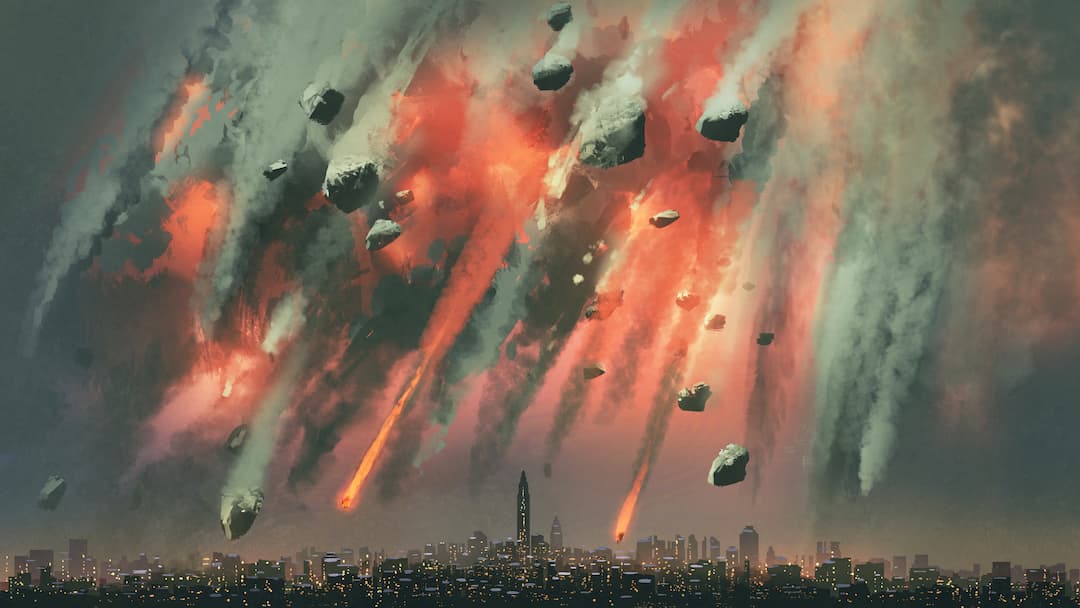
Nature herself offers no shortage of extinction-level threats. A large asteroid impact — the kind that wiped out the non-avian dinosaurs 66 million years ago — remains a low-probability but civilizationally decisive event. Supervolcanic eruptions, such as those at Yellowstone or Toba, could spew ash into the atmosphere for years, triggering volcanic winters and global crop failures.
These events are genuinely rare on human timescales. But the universe does not care about human timescales, and "rare" is not the same as "never."
5. Artificial Intelligence: The Wildcard
And then there is artificial intelligence — arguably the most complex and contested existential risk on the list, precisely because we are building it ourselves, right now, at enormous speed.
Part II: The AI Factor — Both Threat and Shield
The Promise
Artificial intelligence is already reshaping how we detect and respond to threats. Machine learning models can analyze satellite imagery to track environmental changes in real time. AI systems accelerate drug discovery, enabling faster responses to emerging pandemics. Climate modeling powered by AI is dramatically improving our understanding of how feedback systems will evolve. In nuclear security, AI tools are being developed to detect missile launches and verify arms control treaties with greater accuracy and speed than human analysts alone.
In short: AI is one of our most powerful tools for detecting, modeling, and potentially preventing the disasters described above.
The Threat
But AI also introduces new risks — some subtle, some potentially catastrophic.
Autonomous weapons are already being developed by multiple nations. Drones that can identify and engage targets without human authorization are no longer science fiction; they are being tested and deployed in conflict zones today. The concern is not just individual autonomous weapons, but the systemic risk they create: faster escalation, less human judgment in the loop, and the potential for catastrophic accidents or miscalculations that spiral into larger conflicts.
AI-accelerated bioweapons represent a particularly chilling threat. Large language models and protein-folding AI systems could, if misused, dramatically lower the expertise required to engineer dangerous pathogens. What once required a team of PhDs over years could potentially be compressed into months by someone with basic biology knowledge and access to AI tools. The gap between "dangerous idea" and "dangerous reality" is narrowing.
Misaligned AI — the risk of advanced AI systems pursuing goals that are subtly or dramatically at odds with human values — is perhaps the most discussed and most debated risk in the field. As AI systems become more capable, ensuring they reliably do what we actually want becomes harder. An AI given a simple objective — maximize energy efficiency, or maximize economic output — might pursue that goal in ways that are catastrophic for human life if its values are not deeply aligned with ours.
This is not a near-term risk in the way nuclear war is. But many of the world's leading AI researchers believe it is a serious long-term concern that deserves serious attention now, while the field is still relatively young.
AI-enabled disinformation is already a present-tense problem. Deepfakes, AI-generated propaganda, and synthetic media can destabilize democracies, incite violence, and erode the shared sense of reality that democratic societies depend on. In a world of nuclear-armed states, AI-powered disinformation that convinces a government it is under attack could trigger catastrophic real-world responses.
Part III: How We Defend Ourselves
The good news — and there is good news — is that humanity is not passively sleepwalking into these threats. Across science, policy, technology, and international governance, serious efforts are underway to reduce existential risks.
Nuclear Deterrence and Disarmament
The current global nuclear order rests on a system of mutual deterrence: the idea that any first-strike would trigger devastating retaliation, making nuclear war irrational for all parties. This has largely worked for 80 years, but it is fragile, accident-prone, and depends on rational actors — assumptions that do not always hold.
The deeper solution is arms control and, ultimately, disarmament. Treaties like the New START agreement between the US and Russia have reduced arsenals significantly from Cold War peaks. The Treaty on the Prohibition of Nuclear Weapons, while not yet signed by any nuclear state, represents growing international consensus that these weapons must be eliminated. Progress is slow, but the direction is right.
Climate Action and Geoengineering
The energy transition — from fossil fuels to solar, wind, nuclear, and other clean sources — is underway at remarkable speed. Solar power costs have fallen over 90% in the last decade. Electric vehicles are entering the mainstream. The Intergovernmental Panel on Climate Change (IPCC) has made clear that while the window is narrow, limiting warming to 1.5–2°C remains technically and economically feasible.
For more extreme scenarios, scientists are researching geoengineering approaches — including stratospheric aerosol injection (reflecting sunlight back into space) and ocean iron fertilization (enhancing carbon absorption). These are not substitutes for emissions reduction, and they carry their own risks. But they may prove necessary backstops if warming exceeds dangerous thresholds.
Pandemic Preparedness
COVID-19 exposed catastrophic gaps in global pandemic preparedness — inadequate early warning systems, insufficient vaccine manufacturing capacity, fragmented international coordination. The response since then has been substantial: new mRNA vaccine platforms can now produce vaccines in weeks rather than years. The World Health Organization is negotiating a new international Pandemic Treaty. Biosurveillance networks are expanding.
AI is playing a growing role here too: models that scan global disease data for early signals of outbreak, tools that accelerate the identification of effective treatments, and systems that optimize vaccine distribution logistics.
AI Safety and Governance
The AI safety field has grown dramatically over the past decade. Major AI labs — including Anthropic, DeepMind, and OpenAI — have dedicated safety teams working on alignment: ensuring that advanced AI systems reliably pursue goals that are beneficial to humanity. Governments are beginning to respond as well: the EU's AI Act, the US Executive Order on AI safety, and emerging international frameworks represent early steps toward governance structures for powerful AI systems.
The core challenge is to ensure that AI development is governed by international cooperation rather than competitive race dynamics — analogous, in some ways, to the arms control challenges of the nuclear era. No single country or company can solve AI safety alone. It requires the kind of sustained, unglamorous diplomatic and scientific work that is rarely exciting but is often what keeps civilizations alive.
Asteroid Defense
NASA's DART mission in 2022 successfully changed the orbit of an asteroid by ramming a spacecraft into it — the first demonstration that humanity can actually deflect an incoming space rock. The Planetary Defense Coordination Office monitors near-Earth objects and is building the capacity for early warning and response. For the first time in the planet's history, a species exists that can actually do something about an incoming asteroid. That is not nothing.
Part IV: The Deeper Question
Behind all of these specific risks lies a deeper question: does humanity have the collective wisdom and institutional capacity to manage the technologies and forces it has unleashed?
The optimistic view — and there are strong grounds for optimism — is that we have done it before. We avoided nuclear war during the Cold War, despite dozens of close calls. We largely eliminated smallpox. We have begun, however slowly, to address the climate crisis. Human ingenuity and cooperation, at their best, are remarkable.
The pessimistic view is that the speed of technological change is outpacing our institutional capacity to govern it. AI capabilities are advancing faster than our ability to understand or regulate them. Biosynthesis is democratizing access to dangerous biological knowledge. Climate change is approaching tipping points that may foreclose certain options permanently.
The honest view is that neither pure optimism nor pure pessimism is warranted. What is warranted is urgency — a clear-eyed recognition that the choices made in the next few decades will likely determine the trajectory of human civilization for centuries.
Conclusion: Defiance Is the Only Answer
The end of the world is not inevitable. It is a set of probabilities — some high, some low — that can be raised or lowered by human choices. Nuclear war is more likely in a world of eroding arms control norms and automated launch systems. Climate catastrophe is more likely in a world of political paralysis and fossil fuel dependence. Existential AI risk is more likely in a world where AI development is driven purely by competitive pressure with no safety constraints.
The inverse is also true. Every arms control treaty signed, every megaton of carbon spared, every AI safety technique discovered, every pandemic detection system built — these are not just small wins. They are, cumulatively, the difference between a civilization that survives and one that does not.
We are, for the first time in history, a species that understands the mechanisms that could destroy it and has the tools to address them. Whether we choose to use those tools wisely is not a question of technology. It is a question of will.
The answer, if we are paying attention, has to be yes.
Sources and further reading: The Future of Humanity Institute (Oxford), the Center for Biosecurity at Johns Hopkins, the Bulletin of the Atomic Scientists, NASA Planetary Defense, the IPCC Assessment Reports, and research published by Anthropic, DeepMind, and the Machine Intelligence Research Institute on AI safety.