Quantum Tunneling: When Particles Act Like Ghosts!
This Article aims to explain quantum tunneling in simple terms using analogies and more to help you succeed in life!
This is an automatic translation. Read the original
Introduction
Imagine you're playing basketball and you throw the ball at a wall. The ball will bounce off the wall, right? You'd never expect the ball to magically pass through the solid wall and appear on the other side. That's how our everyday world works—objects can't pass through barriers.
But in the quantum world (the world of atoms and subatomic particles), something truly bizarre happens: particles can actually pass through barriers that should be impossible to cross. This phenomenon is called quantum tunneling, and it's one of the strangest and most useful behaviors in physics.
What is Quantum Tunneling?
Quantum tunneling is a quantum mechanical phenomenon where a particle has a chance of appearing on the opposite side of a barrier, even though it doesn't have enough energy to go over the barrier. It's as if the particle can temporarily "borrow" energy or find a hidden tunnel through the obstacle.
To understand why this is so strange, let's first think about energy and barriers. In our everyday world, if you want to get over a wall, you need enough energy. If you don't have enough energy, you can't make it—simple as that. But particles operating under the rules of quantum mechanics don't follow this rule.
The Quantum World is Different
Before we dive deeper into tunneling, you need to understand that the quantum world (atoms, electrons, photons) works very differently from the world we see with our eyes.
Key difference: In the quantum world, particles don't have definite locations. Instead, they exist as a kind of probability cloud. An electron isn't at one exact spot—it has a certain probability of being found in various locations. This is described by something called a "wave function."
Think of it like this: imagine you're playing hide-and-seek, but instead of hiding in one exact spot, you're spread out as a probability of being in different locations. You might have a 60% chance of being behind the tree, a 30% chance of being behind the rock, and a 10% chance of being behind the house.
How Does Tunneling Work?
Now here's where tunneling comes in:
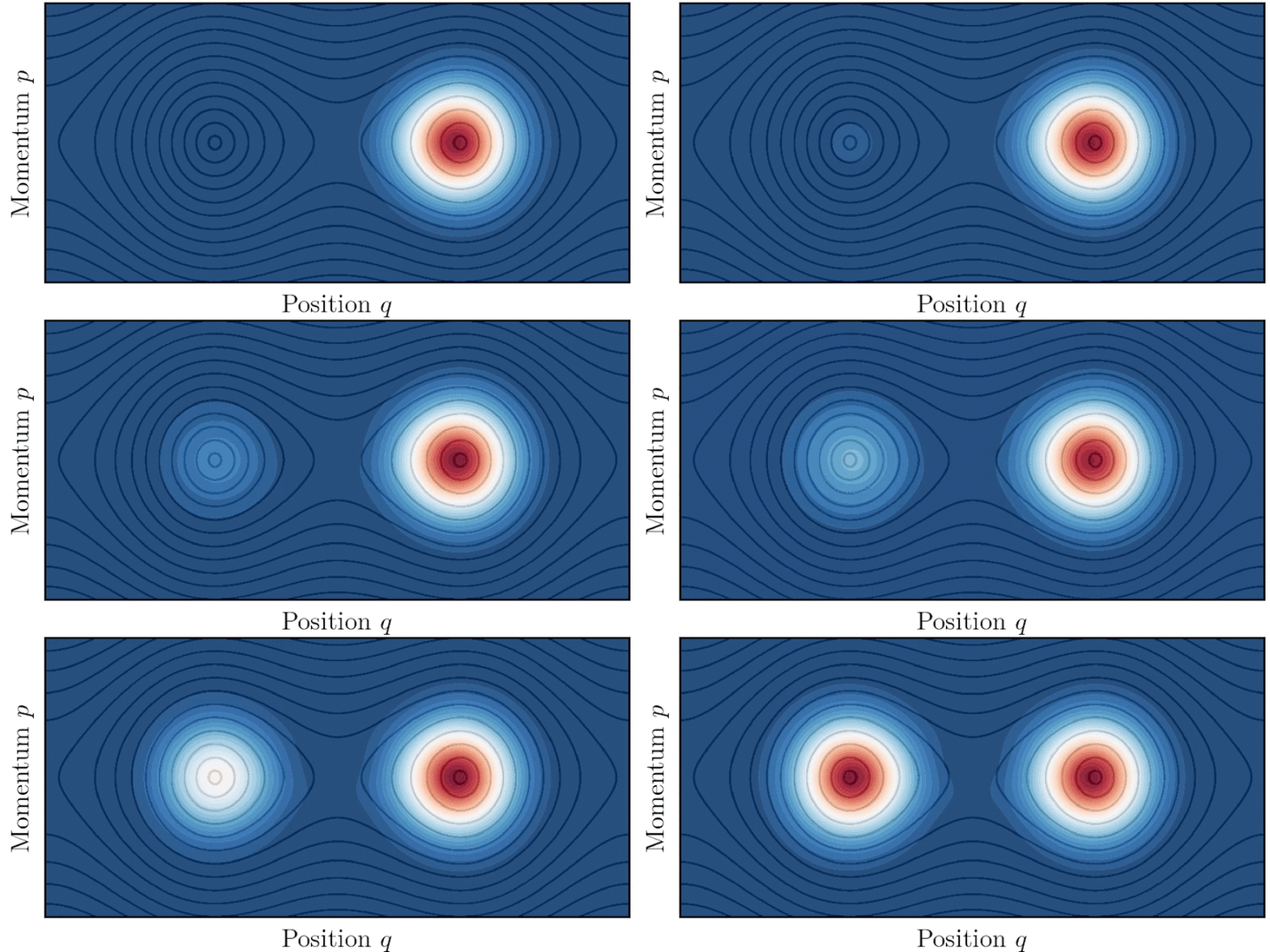
When a particle approaches a barrier, its probability wave doesn't just stop at the barrier. The wave function actually extends through the barrier and comes out on the other side. Even though the particle isn't supposed to have enough energy to cross the barrier, there's a small probability that it will be found on the other side.
It's not that the particle travels through the barrier in a continuous path. Rather, it's more like the particle has some probability of vanishing from one side and reappearing on the other side. We don't know exactly how it gets through—quantum mechanics doesn't really tell us that. It just tells us the probability that it will get through.
An analogy: Imagine you're trying to get over a mountain. Normally, you need to have enough energy to climb the whole way up and over. But in the quantum world, it's like there's a small chance you'll suddenly appear on the other side of the mountain without climbing it. The higher the mountain (the stronger the barrier), the less likely it is. The wider the mountain (the wider the barrier), the less likely it is. But there's always some chance, no matter how small.
Key Factors That Affect Tunneling Probability
Three main things determine how likely a particle is to tunnel through a barrier:
1. The Height of the Barrier The higher the energy barrier compared to the particle's energy, the less likely tunneling becomes. A huge barrier means a tiny probability.
2. The Width of the Barrier The wider the barrier, the less likely tunneling is. A thin barrier might have a decent tunneling probability; a thick barrier almost zero.
3. The Mass of the Particle Lighter particles tunnel more easily than heavier particles. Electrons tunnel readily; larger particles tunnel with much lower probability.
This is why we rarely observe tunneling with objects we can see—they're too massive. But for electrons and other tiny particles, tunneling is very common and important.
Where Does Quantum Tunneling Happen in Real Life?
You might think tunneling is just a theoretical curiosity, but it actually happens all around us and inside things we use every day:
The Sun and Stars
The Sun's power comes from nuclear fusion—atoms combining to form heavier atoms. But here's the problem: the nuclei of atoms have a huge energy barrier that should prevent them from getting close enough to fuse. Without quantum tunneling, the Sun wouldn't shine! Particles tunnel through the barrier and fuse, releasing the enormous energy that lights and warms our world.
Radioactive Decay
Some atoms are unstable and decay, shooting out radiation. The particles inside the nucleus can tunnel out through the energy barrier that should trap them. This is why radioactive materials gradually lose their atoms over time.
Scanning Tunneling Microscopes
Scientists have invented a microscope that works based on tunneling. An extremely sharp needle gets very close to an object, and electrons tunnel across the tiny gap between the needle and the surface. By measuring this tunneling current, scientists can see individual atoms! This was so revolutionary that its inventors won the Nobel Prize in Physics.
Transistors and Computer Chips
Modern computer chips use the principle of tunneling. In fact, as transistors get smaller and smaller, tunneling becomes a bigger and bigger problem that engineers have to account for. The tiny pathways in your computer chip are so narrow that electrons tunnel across barriers that are supposed to block them.
Future Applications of Quantum Tunneling
Scientists are actively working on ways to harness and use quantum tunneling. Here are some exciting possibilities:
Quantum Computers
One of the most promising uses of quantum tunneling is in quantum computers. These computers work by using quantum phenomena like tunneling to process information in completely new ways. Quantum computers could theoretically solve certain problems much faster than regular computers—like breaking encryption codes or designing new medicines.
More Efficient Solar Panels
Researchers are working on solar panels that use tunneling to capture more of the Sun's energy. By understanding how electrons can tunnel across barriers in materials, scientists might create solar cells that are far more efficient than today's panels.
Smaller and Faster Electronics
As we try to make computer chips smaller and faster, tunneling becomes important. Understanding tunneling allows engineers to design better tiny circuits and transistors. Some researchers are even exploring using tunneling itself as a feature—like tunneling transistors that work in new ways.
Better Batteries
New battery designs might use tunneling effects to improve how ions move through the battery's materials. This could lead to batteries that charge faster and hold more energy.
Quantum Sensors
Devices that use tunneling effects could become incredibly sensitive sensors, able to detect tiny changes in magnetic fields, electric fields, or other properties. This could revolutionize medical imaging and other detection technologies.
Fusion Energy
If scientists can better understand and control tunneling, they might be able to create controlled fusion reactors on Earth—the same process that powers the Sun. This would be a nearly unlimited, clean source of energy.
Why Is Tunneling So Strange and Important?
Quantum tunneling shows us something profound: the universe at the smallest scales doesn't work the way we might expect. It challenges our everyday intuitions about how solid things are and how barriers work.
But rather than being useless, this strangeness is incredibly powerful. By understanding tunneling, scientists can:
- Explain why stars shine
- Create new technologies
- Design better electronics
- Potentially solve humanity's energy problems
Conclusion
Quantum tunneling is a perfect example of how the quantum world is genuinely strange and different from our everyday experience. Particles don't behave like basketballs or rocks. They can pass through barriers that should stop them. There's no tunnel they're traveling through—they simply have a probability of appearing on the other side.
What makes this even more remarkable is that this bizarre phenomenon isn't just theoretical. It's happening right now in the Sun, in the Earth's radioactive materials, and in the transistors of your computer. As technology advances, scientists are finding more and more ways to use tunneling, from quantum computers to fusion energy.
The quantum world might seem strange and disconnected from everyday life, but it's actually the foundation of everything—and understanding it opens up incredible possibilities for the future.

