Dark Stars: The Stars as Bright as Galaxies
Theoretical dark stars might have caused supermassive black holes creation!
The Black Hole Mystery
For over a decade people have pondered about the creation of supermassive black holes, black holes so large that they should not have been able to have been created, and yet they are found at the center of most galaxies, including our own. But in the past decade, new light has been shed on these giants and the possible theory of a star the size of a galaxy, fuelled by dark matter, and it is even possible that we have seen these stars ourselves!
The Formation of Dark Stars
Stars are formed when a cloud of dust and gas collapses due to gravity, which fuses elements together, such as hydrogen into helium, and helium into oxygen when the hydrogen runs out. This pushes against the gravity, creating an equilibrium between the nuclear fusion and gravity, and creating most of the elements in the universe. When the star starts trying to fuse iron though, the iron is so heavy that it cannot, and it implodes. From here three things can happen:
- The first, for a lighter or smaller star like our sun, as the gravity hits the core, the entire star will expand outwards into explosion, fusing all the heavier elements found in the universe and scattering them, creating a supernova and leaving a white dwarf in the center.
- The second option, for a very large star, is to leave a neutron star in the center of the supernova instead of a white dwarf, which is an extremely dense star that has two "pulsars" on either end which are made of streams plasma.
- The final option, if the star is exceptionally heavy, is to create a black hole, which is so dense that not even light can escape, and anything that goes past its event horizon it sucked in.
But no star is large enough to create a supermassive black hole, like the one at the center of the milky way (not the chocolate) and other spiral galaxies.
This is why Katherine Freese had the idea of a dark matter star that would be so large it would be able to create a supermassive black hole.
Dark matter is the mysterious matter that makes up most of the matter in the universe, that acts as its scaffolding, holding large structures like galaxies and galaxy clusters together. Physicists think that it is made up of Weakly Interacting Massive Particles, or WIMPs for short, and that dark matter produces large amounts of energy when they collide.
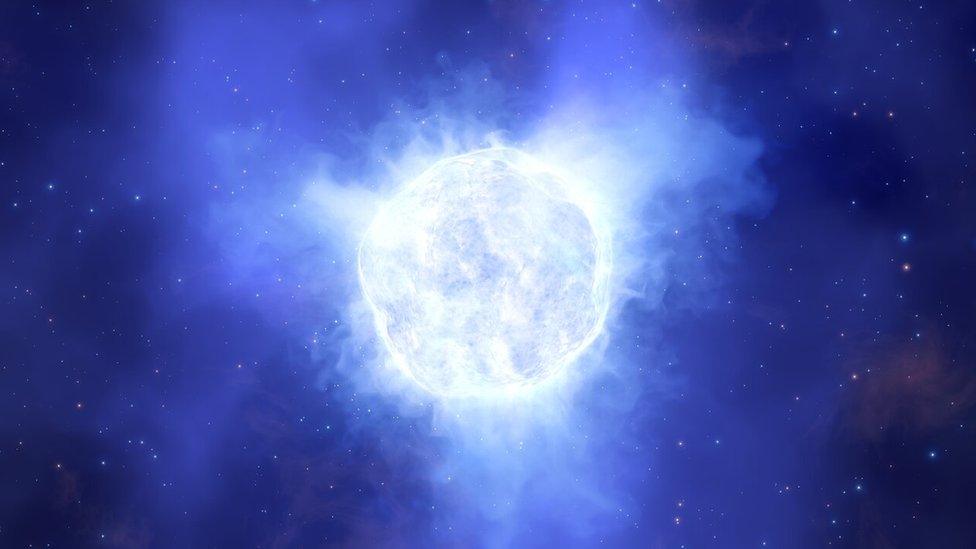
During the beginning of the universe, shortly (in cosmological terms) after the big bang, there were no large structures such as stars and galaxies, just particles scattered across the universe. Dark matter, though, moves more slowly allowing it to gather more easily, creating huge structures of dark matter "halos", which would attract normal matter as well, which went on to create stars, and galaxies. If some of these halos were dense enough though, the heat energy produced by the WIMPs would be so strong that it would actually push against gravity as nuclear fusion would, preventing the pre-star from forming and making it expand to the size of saturn's orbit around the sun, and turning it into a "puffy" cloud-like mass of hydrogen and helium.
Now this may seem small, considering that many galaxies are littered with red supergiants this very size, but the dark star is millions of times more massive than them, making it much more extreme. These dark stars would only need to contain 0.1 percent dark matter, and yet they would still have trillions of annihilations every second, making the star shine brighter than entire galaxies, certainly not living up to its name.
At some point of course though this star would have run out of dark matter to annihilate, becoming an enormous and bright star powered by nuclear fusion, which it would continue to do until it inevitably collapsed into a black hole. But this is no normal black hole. This is a supermassive black hole that is usually found at the centre of most galaxies, even our own, a billion times more heavy than a standard, run of the mill black hole, becoming the solution to the great mystery pursued for over a decade by physicist about how supermassive black holes were created. It is important though to remember though that this is still a theory, and does not have definitive evidence yet.
The History of Dark Stars
Just how was the idea of dark stars created though, and by whom?
The Timeline:
- The idea was first presented in 2007 by a theoretical astrophysicist named Katherine Freese from University of Texas who presented the idea of a Dark Star which was fuelled by dark matter instead of fusion at a conference, but it did not go well, with some people calling them "crackpots".
- Despite the criticism, she and her colleagues continued refining their idea of a dark stars, and in 2008 they published an article on them which sparked large debate among the scientific community.
- The idea really bloomed though when three galaxies were found by the James Webb Space Telescope, (or the JWST for short) that must have formed much earlier than anyone predicted.
The Three Red Dots
In July, 2023 the JWST found three red smudges in the sky, which most likely are small galaxies. To understand the reason this is odd, we have to briefly explain how telescopes work. Basically, the farther we look in space, the earlier in time we see it, due to the fact that it may be billions of light years away, meaning that the light takes billions of years to reach us. The three smudges the telescope found appeared to be galaxies existing only 320 million years after the big bang, much earlier than expected. This confusion led Freese to think that perhaps they might finally be the step to definitive evidence for dark stars, since they do match the estimated light emissions expected from such a star. Later in the search it was also discovered that helium II was detected in ionised form, fitting the predictions for a dark star.
It is still possible that it turns out to be a small galaxy, and many astronomers think so thanks to the strangeness of the dark star theory, it has come a long way from the ridiculous theory that nobody believed in, as the search continues for the final piece of evidence dark stars exist.
"All truths are easy to understand once they are discovered; the point is to discover them" - Galileo Galilei
No AI used in the making of this article.
For more information on dark matter please visit my article on the Dark Big Bang.
Main Source: https://www.newscientist.com/issue/3457/