A Second Big Bang?
Could a second big bang explain the existence of dark matter?
Dark Matter
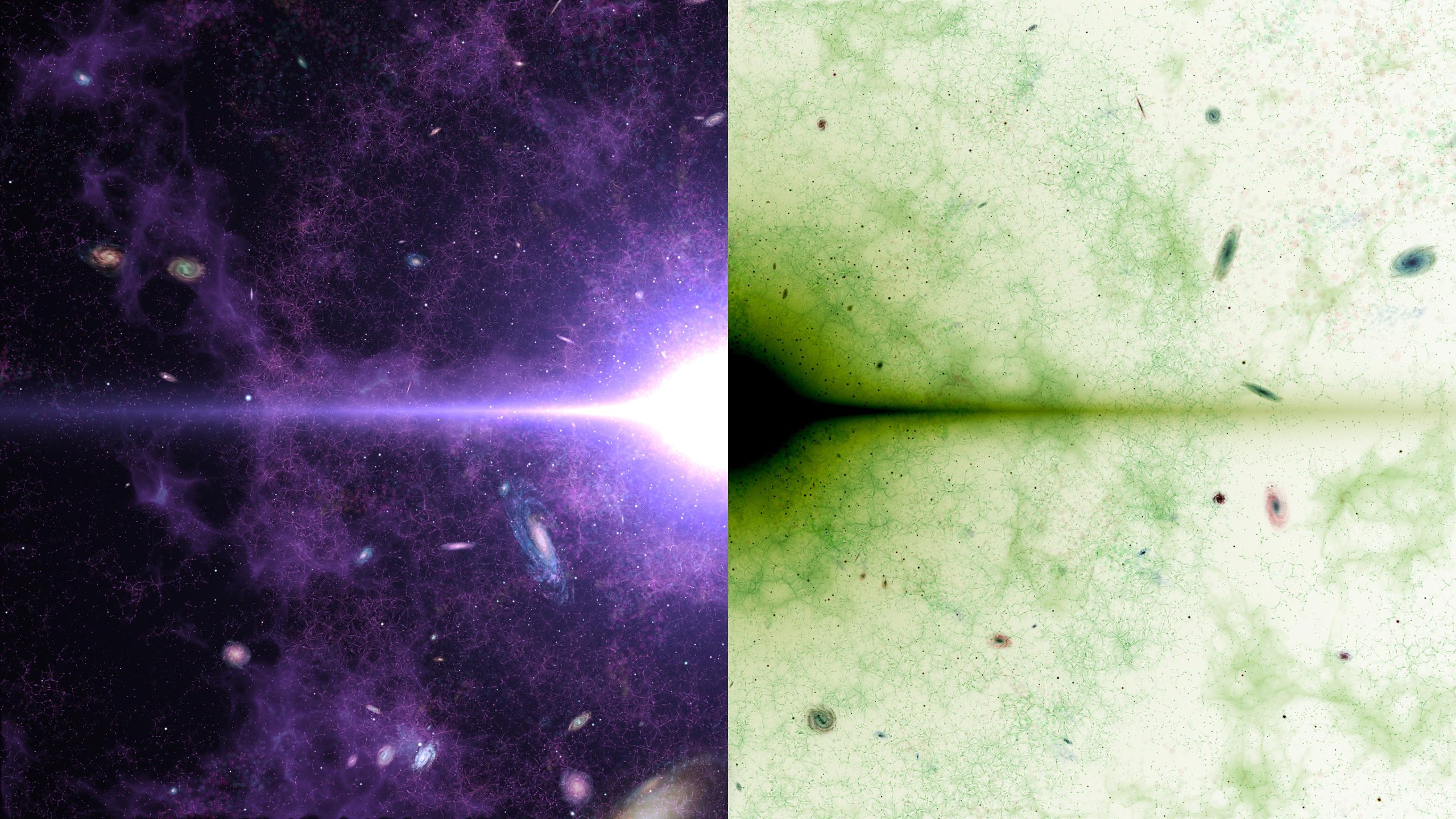
What even is dark matter? Dark matter is an invisible substance that holds large structures together like galaxies and keeping the cosmic web together, seemingly only affected by gravity and very mysterious. It makes up around 27% of the matter in the universe while matter only makes up 5%, and yet even with dozens of searches, none have found any signs of dark matter detection, leading us to believe that perhaps only gravity can affect it.
Discovery of Dark Matter
While no one has actually found dark matter, someone must have figured out it exists, right?
Well it started with a swiss astronomer named Fritz Zwicky who went on to coin the term "dunkle materie" which is dark matter in german. He published a paper in 1933 on a strange occurrence. A cluster of galaxies called the Coma Cluster had galaxies that moved too quickly meaning they should have escaped it, however they stayed together anyway. Dr. Zwicky realised that there might be some strange invisible matter holding the cluster together, though he did not have enough evidence to make it a widely known theory.
Later on in the 1970s the american astronomer Vera Rubin noticed that the stars at the fringes of spiral galaxies should have been flung off into the vastness of space due to the spinning motion of the galaxy, meaning that spiral galaxies should not exist at all. This suggested that there was some kind of matter keeping the galaxy together, but none was visible, so she decided that this must be Zwicky's dark matter, holding together both galaxies and galaxy clusters.
This evidence was so clear that it is now widely accepted by the scientific community, though it remains unclear as to what actually it is.
Important Notice:
Before we continue, it is important to point out that dark matter is not the same thing as dark energy. Dark energy is the mysterious force that is making the universe expand, while dark matter is what keeps large structures such as galaxies together.
And back into the article:
The Dark Big Bang
Physicists have been searching for dark matter for over 40 years, but to no avail. They have been conducting experiments in search for Weakly Interacting Massive Particles, or WIMPs for short. Scientists hope that if these WIMPs do exist that they would interact with weak nuclear force as well as gravity, meaning that they would react with atomic nuclei. What physicists do is watch vats of very dense liquid, hoping to see a flash of a dark matter particle collide with a nucleus of one of the atoms.
However, this has proved no results so far proposing that dark matter is not affected by the weak nuclear force, which some physicists call the "nightmare scenario" because gravity affects things very little on such a small scale.
Katherine Freese thinks that the key to finding dark matter is to understand its origins. Freese and Martin Winkler suggested in February 2023 that there might have been another big bang, a few weeks after the traditional "hot big bang", calling this the "dark big bang", which may have given birth to the dark matter particles that make up almost a third of the universe today.
"People always assume everything is created at the same time in a single big bang, but who really knows?" says Freese.
Back in 1949 scientists were at first sceptical of the idea of a big bang, but in 1964 they found the Cosmic Microwave Background, or CMB for short, which is only explained by a big bang. Freese hopes to find a similar kind of background hum made of gravitational waves instead, giving evidence that it exists.
You see, the calculations of Freese and Winkler propose that there are three different possibilities for a dark big bang, each with different particles, though all would have to have happened within about a month of the hot big bang so as not to affect the creation of the universe in a different way than how we see it today.
"You have to be absolutely sure that you don't mess with the standard evolution of cosmology." - Katherine Freese
- The first dark big bang is an abrupt one, which produces large expanding "bubbles" which release energy as they collide. The bubbles would be so energetic that they could be 10 trillion times the mass of a proton, which is why Freese and Winkler call "Darkzillas", after the fictitious Japanese monster "Godzilla".
- If the dark big bang was a more gradual process, then the particles would be produced would be lighter, and would be the WIMPs that so many scientists are looking for, which would have their own forces of nature, such as dark electromagnetism to make dark photons.
- However, if these dark forces don't exist in the gradual solution, then you are left with these dark matter particles that can't balance their energy causing them to engulf each other as they collide.
Of course though, these are only some of the possibilities for a dark big bang, however it is still unclear where the energy for a dark big bang would come from.
But what has this got to do with gravitational waves? Well Freese says that the colliding bubbles would leave gravitational ripples in space time known as gravitational waves, similar to the CMB produced by the hot big bang. It is actually possible that we have already detected these waves, as we have been detecting them since 2016 finding over a hundred of them. They are usually caused by collisions of dense objects like black holes or neutron stars, but there is a kind of background hum that could more likely be produced by distant black holes colliding, but it could also be the signals of a dark big bang.
"The [energy] scales we're talking about for the dark big bang are perfect for bubble collisions that would give you [these] signals." says Dr. Freese
Whether this theory will stand the test of time or whether it will be disproven, the search goes on to find evidence that there really was a dark big bang.
Truth is ever to be found in the simplicity, and not in the multiplicity and confusion of things. - Isaac Newton
Sources:
Cover Image: https://scitechdaily.com/images/Dark-Big-Bang-Comparison-scaled.jpg
Information Source 1: New Scientist 11 November 2023: https://www.newscientist.com/issue/3464/
Information Source 2: https://science.nasa.gov/dark-matter/